
Tungsten inert gas (TIG) and metal inert gas (MIG) welding are the most common forms of the gas-shielded arc welding process family, using a high powered DC arc to deliver the required energy for jointing.
While closely related in principle, they differ substantially in equipment, technique, electrode type, precision, and productivity. Manufacturers typically evaluate their selection for an application based on three aspects: speed, quality, and material requirements.
Selecting the right process affects not only weld performance but also part design, budget, and production scalability. This guide delivers a structured, engineering-level comparison to assist in selecting the optimal process for an assembly manufacturing needs.
Key takeaways
- TIG welding uses a non-consumable, Tungsten electrode to form the arc and typically requires a separate filler rod, delivering high-precision welds.
- MIG welding requires a continuous consumable wire filler, fed automatically through a gun and acting directly as the electrode. This delivers faster, higher-productivity, lower precision welding.
- The core trade-off: TIG delivers precision and quality appearance, MIG delivers speed and production efficiency.
- TIG demands considerably more operator skill; MIG is beginner-friendly and easier to automate.
- TIG excels at thin materials, exotic alloys, and visible welds; MIG excels at general fabrication, thicker materials, and long production runs.
- Hybrid TIG MIG welding – where a joint is formed by dual welding heads – a Tungsten electrode for initiating the weld pool and then an autofeed wire electrode to complete the joint, operating in a single action.
TIG Welding: Precision and control
TIG welding, also known as gas-Tungsten arc welding (GTAW) is considered the quality-pinnacle when weld strength, cosmetics, and precision are the priority. It can be viewed as the electrical interpretation of oxy-acetylene flame welding, requiring analogous and equally high skill levels. TIG uses a Tungsten electrode to create an arc, the electrode being barely eroded by the process, only requiring moderate clean-up by grinding after prolonged use. Where required, additional (joint compatible) filler metal is manually or automatically fed into the arc area or melt pool, to supplement the available material for jointing. This separation of arc control from filler delivery enables exceptional refinement of the weld bead, tight control of heat input, and very precise weld pool or puddle dynamics.
Its slow linear-joint speed, when compared to MIG, is the trade-off that manufacturers must tolerate when the application demands the tighter tolerances, improved cosmetics, or more precise control needed, particularly when welding highly heat-sensitive (i.e. thermally conductive and low melt viscosity) alloys.

How TIG welding works
- A tungsten electrode generates a stable arc.
- The molten weld pool is shielded by inert gas (pure argon most commonly).
- The operator adds filler metal manually, or in fusion welding, uses no filler at all but ‘works’ the surrounding material into the joint.
- Foot pedal or fingertip amperage control allows real-time heat modulation.
- Precise heat input minimizes distortion, especially on thin sections.
The key technical advantage of TIG lies in independent control: the welder governs heat, torch angle, filler feed, and traverse speed separately, necessary for more intricate or delicate joints.

Key advantages of TIG welding
- Superior weld aesthetics result from higher operator skills (or smarter, more closed loop controlled automation) with clean, uniform beads.
- Excellent heat control, reducing distortion and burn-through on thin metals.
- Highly versatile for stainless steels, Aluminum, Magnesium, Titanium, Inconel, and other performance and super-alloys.
- No spatter, reducing post-processing and cleanup time.
- Best choice for root passes in critical piping and pressure equipment, because of the complete and undisturbed integration of components at the joint line.
- Strong, reliable welds with low defect rates when executed precisely – either in manual or automated operation.
Typical TIG welding applications
TIG is most widely applied to:
- Aerospace and motorsport components, where integrity is a greater concern than cost or productivity
- Medical devices and food-grade stainless steel assemblies, where detritus traps and porous inclusions can offer reduced sterilization and potential user hazards
- Architectural metalwork, and artistic/ornamental fabrication, where aesthetics are paramount and mass production does not typically apply
- Precision instrument housings, when cosmetic quality and robustness over-ride cost issues.
- High-purity piping (pharmaceutical, dairy, semiconductor), as the inclusion/slag free and non oxidized joints lower contamination risk.
MIG Welding: Speed and efficiency
Metal inert gas (MIG) welding, also called gas-metal arc welding (GMAW), is engineered for speed and repeatability. This system feeds a fine consumable wire electrode (of compatible filler material) continuously through the gun, allowing operators to weld rapidly with minimal interruption. Shielding gas protects the arc, though flux-cored wires allow gasless operations, with some slag and quality influences.
For fabrication environments where throughput, cycle time, and cost efficiency matter, MIG is typically the first choice. For operations that are performed with only moderate skill, MIG is a good option as it is among the easiest of welding methods to develop basic competence in.

How MIG welding works
- A continuous wire electrode is fed automatically through a welding gun, at a user controllable rate.
- The wire simultaneously acts as electrode and filler metal, liquifying in its own arc and forming the weld.
- Shielding gas (argon, or blends of Argon and CO2, or pure CO2 ) excludes atmosphere from the weld, to control oxidation/burning and resulting slag formation.
- Operators adjust voltage, wire feed speed, gun orientation, motion pattern and travel speed to optimize weld performance.
- The technique is stable, fast, and easy for beginners to learn.
The automated filler delivery is the primary characteristic advantage of the process: MIG welders can maintain long, continuous beads without the typical variability that results from manual feed of filler.

Key advantages of MIG welding
- Very high deposition and weld progress rates, ideal for production environments.
- Fast learning curve, making it accessible for new practitioners.
- Reduced downtime thanks to robustness of equipment and simplicity of the business-end of the gun.
- Versatile for steel, stainless, Aluminum (when using local filler wire delivery in a spool gun), and super-alloys.
- Easily automated, enabling robotic MIG cells for mass production.
- Good penetration for heavier gauge jointing.
Typical MIG welding applications
MIG is dominant in:
- Automotive manufacturing and repair
- Heavy fabrication and structural steel
- General and moderate precision welded assemblies and frames
- Agricultural equipment
- Furniture, racks, and consumer products
- Robotic welding lines
Direct comparison: TIG vs MIG welding
These sections offer structured, engineering-level comparison of the processes.
Process mechanics comparison
| Feature | TIG Welding | MIG Welding |
|---|---|---|
| Electrode Type | Non-consumable tungsten | Consumable wire |
| Filler Metal | Manual rod or none (fusion) | Continuous wire feed |
| Shielding Gas | Pure argon (mostly) | Argon/CO2 blends |
| Arc Characteristics | Narrow, focused, highly controllable | Wide, stable, high-deposition arc |
| Heat Control | Pedal/finger controls allow modulation | Controlled via voltage & wire feed |
| Spatter | None | Moderate (unless pulse MIG) |
| Cleanliness Needs | Very high | Moderate |
TIG separates heat and filler, enabling accuracy. MIG combines them for speed and efficiency.
Skill level and learning curve
| Factor | TIG | MIG |
|---|---|---|
| Learning Difficulty | High | Low |
| Hand Coordination | Precise multi-axis control | Basic gun control |
| Heat Management | Manual and continuous | Mostly preset |
| Training Time | Weeks–months | Hours–days |
| Best For | Skilled welders | Beginners & production teams |
TIG demands more practice due to tungsten control, filler timing, and heat modulation. MIG is much easier because the machine feeds filler automatically and maintains a stable arc.
Welding speed and productivity
- MIG is typically considered to be 2 to 6 times faster in welded-length productivity than TIG depending on material thickness.
- TIG is slowest but provides the utmost quality, when skillfully performed.
- MIG supports continuous welds, reducing cycle time, where TIG is typically only capable of steady quality for lengths of a few inches.
- TIG often includes longer setup and more precise fit-up.
Production environments overwhelmingly prefer MIG for throughput, while TIG is chosen when quality needs outweigh the resulting cost-up.
Weld function comparison
Strength depends on material, preparation, and operator skill. However, general trends apply:
| Factor | TIG Strength | MIG Strength |
|---|---|---|
| Tensile Strength | Very high when executed correctly | High, but slightly lower due to spatter/porosity risk |
| Penetration | Controlled, ideal for thin material | Deep, consistent on medium/thick sections |
| Defect Rates | Very low if performed cleanly | Higher risk of porosity/spatter |
| Suitability for Structural Work | Excellent for thin precision structures | Preferred for heavy structural steel |
MIG can produce stronger welds on thick materials due to higher deposition rates and deeper penetration. TIG produces stronger welds on thin or exotic materials due to heat control and purity.
Weld quality and appearance
- TIG produces clean, uniform weld beads with no spatter, optimal for weather and cosmetically exposed surfaces.
- MIG is strong but produces more spatter and less aesthetic bead geometry.
- TIG welds require less (typically no) post-processing, when executed optimally.
- MIG welds often need dressing/grinding (or at least wire brush cleaning) unless pulse MIG is used.
Material compatibility: TIG vs MIG
Material performance is a crucial design factor. Different materials behave differently under the heat and deposition characteristics of each process.
Stainless steel welding comparison
- TIG creates exceptionally clean stainless welds with minimal contamination.
- MIG is suitable for structural stainless but typically will produce oxidation and bluing discoloration.
Aluminum welding comparison
- TIG is best for thin Aluminum and complex geometries, due to the typically high precision of the process and parameter control..
- MIG ( with a spool gun) is ideal for thicker aluminum sections due to greater deposition speed and reduced risk of local slumping from overheat.
Mild steel and carbon steel comparison
- MIG is the standard choice for most carbon steel fabrication due to processing speed and penetration.
- TIG is used for specialty Carbon steel work requiring high quality appearance or ultra-low defect/porosity/inclusion rates.
Thin materials vs thick sections
- TIG is superior for materials under 3 mm due to its superior heat control.
- MIG excels on 3–12 mm sections and can handle thicker ones with correct settings and multi-pass welding of bevelled or open joints.
TIG vs MIG Welding: Design, costs, automation, and choosing the right process
The following focuses on practical considerations for selecting TIG or MIG welding, derived from design requirements, equipment availability, costs, and automation. It also explores how joint geometry, access, heat management, and surface preparation influence process choice, to help in design and operational choices.
Design considerations: TIG vs MIG
Joint design differences
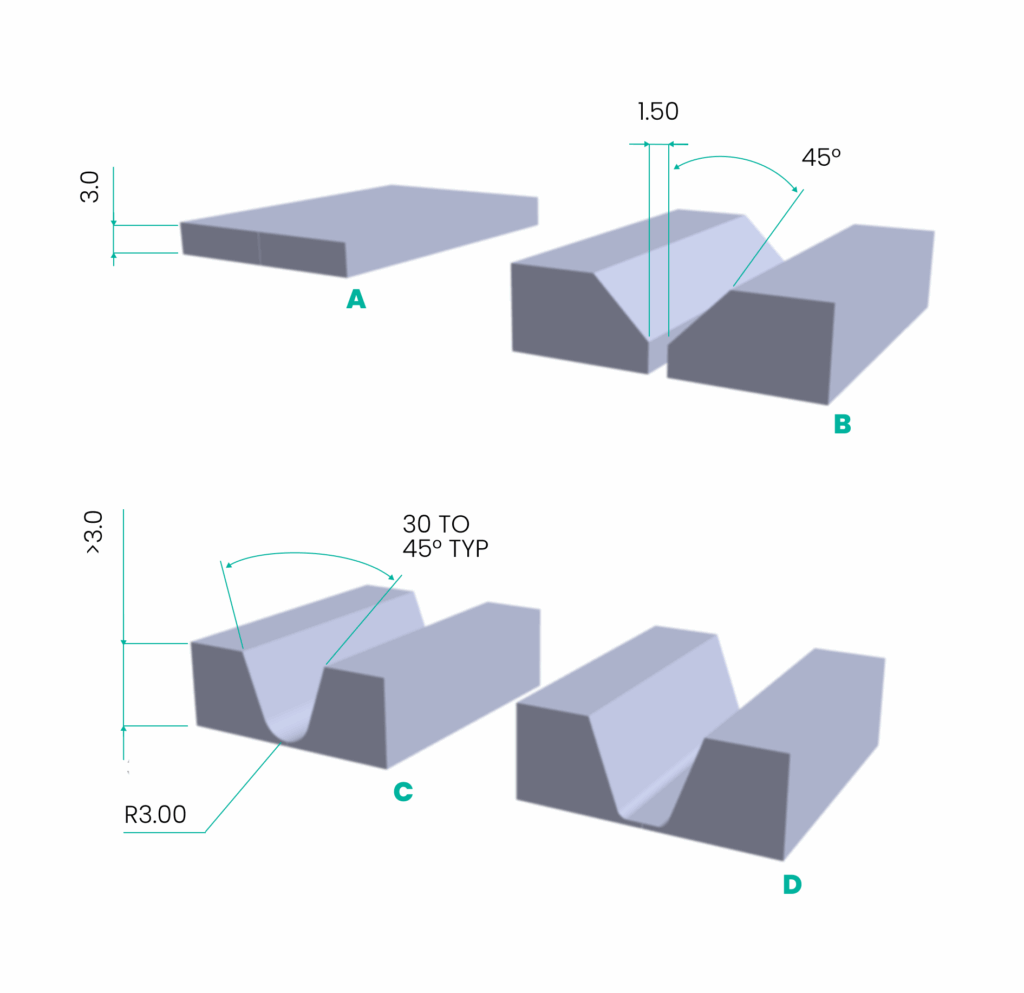
- TIG welding demands precise edge preparation, close tolerances, and good quality fit-up due to lower deposition rates and a typically more unforgiving process. It is ideal for butt, lap, and corner joints where aesthetics and penetration are critical and slower production can be tolerated.
- MIG welding is more forgiving of joint gaps and fit-up imprecision. It works well with lap, fillet, and groove welds in thicker materials, and is much less dependent on quality of edge prep, when compared to TIG.
Access and positioning requirements
- TIG torch clearance and foot pedal control commonly influence welding positions/orientation. Overhead and vertical welding require advanced skills, to prevent slumping and irregularity of puddle dynamics due to adverse gravity.
- MIG: Easier to maneuver in multiple positions, suitable for high-volume production, and easier to automate with robotic cells. MIG is less affected by orientation, as the weld rate encourages more rapid puddle development/solidification which reduces slump risk.
Distortion and heat management
- TIG’s low heat input reduces regional and local distortion and trapped-stress, making it ideal for thin sheets and exotic alloys with low thermal conductivity.
- MIG delivers higher heat input, increasing risk of warping in thin materials but these characteristics are beneficial for deep penetration in thicker jointing.
Surface preparation requirements
- TIG requires extremely clean surfaces; contaminants lead to porosity and weak joints.
- MIG is more tolerant but still benefits considerably from clean, oxide-free surfaces that otherwise induce spatter, porosity and inclusions.
Equipment and cost comparison
Initial quipment investment
| Feature | TIG | MIG |
|---|---|---|
| Machine Cost | Higher, includes foot pedal control | Moderate, wire feeder included |
| Gas Requirements | Argon or He, precise flow control | CO2, Argon mixes; larger cylinders feasible |
| Consumables | Tungsten electrodes, filler rods | Wire spools, contact tips |
Operating costs and consumables
- TIG offers relatively low deposition rates, but higher labor cost; electrodes must be replaced periodically and dressed more frequently, and higher skill levels required in operators (or higher capability in automation) imply higher per-inch costs.
- MIG: Faster deposition reduces labor per part; wire feed is continuous. However, dressing can be a high (and quite skilled) additional labor cost that should not be ignored.
Maintenance requirements
- TIG requires regular tungsten dressing (sharpening) and torch maintenance standards demand typically high hygiene levels.
- MIG wire feed rollers, nozzles, and gas regulators require upkeep. However, non-optimally maintained MIG equipment can continue to function at an adequate level, for non-cosmetic and lower inspection-standards work.
When to choose TIG welding
- Projects needing exceptional weld quality and appearance.
- Thin materials (<3mm) prone to burn-through or slumping due to narrow weld to melt window.
- Exotic or non-ferrous metals like Titanium, Aluminum, Copper alloys.
- Visible welds where aesthetics matter.
- Root passes in critical pipe welding. These can be followed by MIG, for higher productivity with certainty of gas/fluid tightness and joint contamination reduction
- Artistic or architectural metalwork is typically TIG welded, as it combines high aesthetic standards with low production volumes and high end-product value.
When to choose MIG welding
- High-volume production runs.
- Thicker materials (3 to 12mm) demanding high production speed and moderated cost.
- Long continuous welds or seam welding.
- Projects where speed outweighs finish.
- Outdoor or field welding with flux-core wire, where gas supply is impractical.
- Structural fabrication, automotive, and construction projects where aesthetics are of low importance.
- Beginners or semi-skilled operators learning welding fundamentals will be able to achieve surprisingly good results with limited knowledge or experience.
Automation capabilities: TIG vs MIG
Automated TIG welding systems
- Orbital TIG systems are widely used to deliver consistent pipe welding.
- Robotic TIG suitable for precise aerospace or nuclear applications.
Automated MIG welding systems
- High-speed, automated robotic MIG cells are widely exploited in automotive and defence materiėl production.
- The process is well adapted to long welds, high-volume runs, and multiple axes of motion for gun orientation.
AI and quality control integration
- Both processes can integrate with sensor-driven monitoring and AI quality assurance, to enable high quality data for Industry 4.0 contexts.
- MIG automation is more common for volume; TIG automation is highly specialized and can be costly.
Making the right choice for your application
Decision criteria:
- Production volume: High-volume favors MIG; low-volume, precision parts favor TIG.
- Material type: Exotic alloys or thin sheets often require TIG; thicker standard metals often suit MIG.
- Weld quality vs speed: TIG prioritizes quality and precision; MIG prioritizes speed.
- Operator skill: Experienced welders enable TIG; MIG is easier for less-skilled teams.
- Budget and equipment: TIG machines may have higher upfront costs; MIG may reduce labor expenses.
Checklist:
- Define material and thickness.
- Evaluate required weld aesthetics.
- Assess production speed needs.
- Consider operator skill and training.
- Decide on automation or robotic integration.
Summary
TIG and MIG welding each serve distinct, though potentially overlapping manufacturing purposes. TIG excels in precision, aesthetics, and thin or exotic metals; MIG offers speed, cost-efficiency, and applicability for thicker materials and/or high-volume production.
Both processes can be automated, though MIG is more commonly performed by industrial robotics. To some extent, this is the result of TIG applications being of typically lower volume.
By understanding process mechanics, material compatibilities, component and joint design considerations, equipment needs, and skill requirements, engineers and manufacturers can select the optimal welding method for their projects.
Jiga connects customers with verified welding suppliers for both TIG and MIG applications, ensuring quality, speed, and technical guidance for every fabrication need.