
US based CNC machining shop rates in 2026 typically fall between $35 and $200+ per hour, depending on machine type, capability, utilisation, and region. But hourly rate alone is a poor predictor of what your part will cost. In reality, CNC pricing is driven by how setup time, cycle time, material behaviour, tolerances, inspection requirements, and geometry complexity interact. These interactions can involve complex and non-linear relationships, often with asymptotic shifts that result from ostensibly small design, tolerance, and finish alterations
This is why a simple bracket can cost $80, or $8000, depending on how it’s designed and sourced. Many buyers misinterpret prototype pricing as “expensive CNC,” when in fact they are seeing unamortised setup and inefficient geometry, with these costs applied to one, or a few parts, distorting the cost impression relative to even modest production levels.
This guide breaks down CNC machining costs at an engineering level – so you can better predict pricing, fully understand and evaluate quotes, and actively reduce cost through design approaches and more orderly sourcing decisions.
Key takeaways
- CNC machining costs are driven by setup + cycle time × shop-rate + material + finishing + risk, not simply an estimate of process hourly rate alone.
- Tolerances, surface finish, and geometry features (deep pockets, thin walls, small radii) often dominate cost more than material.
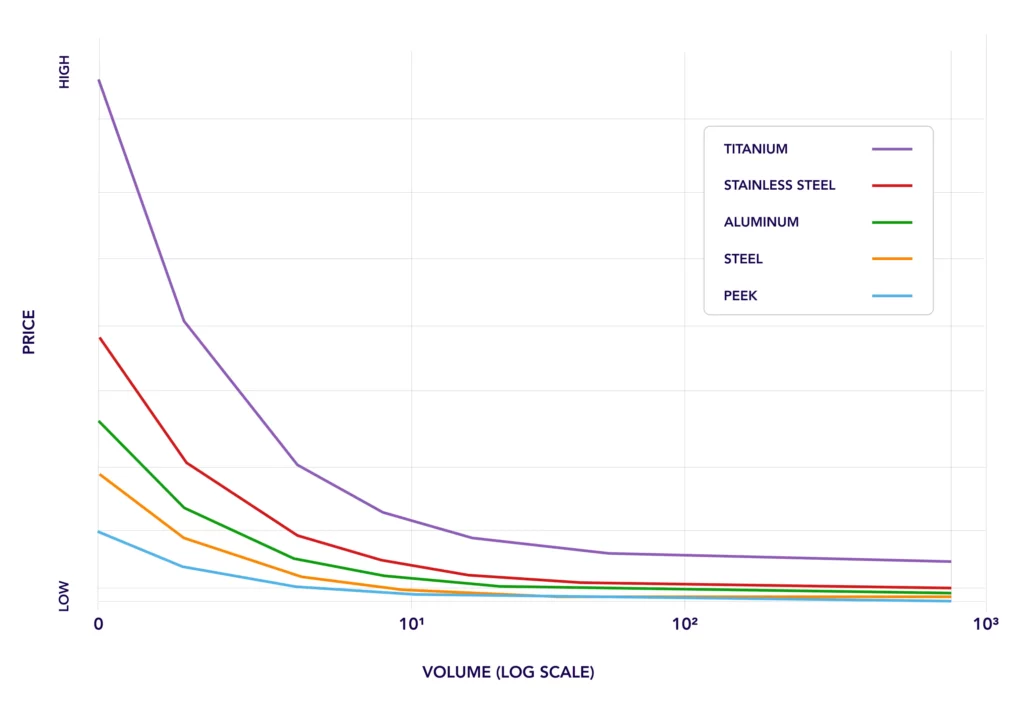
- Prototype pricing appears high because setup is indivisible, but per-part cost drops rapidly with volume.
- The cheapest quote is rarely the lowest total cost – rework, delays, and poor DFM rapidly increase real cost.
- The most effective cost reduction lever is design optimization before quoting, not negotiation after.
How CNC machining pricing is calculated
Every CNC quote, no matter how it’s presented, follows the same underlying structure:
Total Cost ≈ Setup + (Cycle Time × Hourly Rate) + Material + Labour/Handling + Overhead + Secondary Operations
What varies between suppliers is:
- How these elements are bundled or exposed.
- How accurately they estimate cycle time and risk.
- Their internal economics (utilisation, labour model, automation).

What engineers should understand
CNC quoting is not simply, nor even primarily a function of geometry. It is extracted from a structured combination of fixed and variable cost drivers, layered with a risk-assessment based overhead. At its core, setup cost is fixed: programming, fixturing, tool selection, and machine preparation occur once per job, and are then amortized across the production quantity. This is why unit price drops sharply as volume increases – as the setup burden is spread across more parts.
In contrast, cycle time – a partial cost driver – is highly variable and a direct result of part complexity. Geometry drives toolpath length and tool changes; elevated surface finish requirements increase tool-passes and reduce feed and removal rates; material characteristics affect removal rates, chip load, heat issues, and tool wear. Harder or more abrasive materials seriously extend machining time and increase tool costs.
A less visible but critical component is risk pricing. Tight tolerances, complex geometries, or potentially flexure/vibration destabilized features introduce uncertainty. This raises the likelihood of scrap, rework, program iterations, and inspection overhead. Suppliers typically price this implicitly, without itemizing it.
Engineers who understand these relationships can interrogate quotes and interact with suppliers more effectively, enabled to identify where cost changes may be justified, pinpointing overly conservative pricing, and making better-informed trade-offs between performance, manufacturability, and cost.
Typical CNC machining hourly rates by machine type
Hourly rates are best treated as context – not a pricing shortcut.
| Machine Type | Typical Hourly Rate (USD) | Best Suited For |
|---|---|---|
| 3-Axis Mill | $35 to $80/hr | Simple parts, pockets, flat geometries |
| 4-Axis Mill | $60 to $125/hr | Indexed machining, reduced setups |
| 5-Axis Mill | $100 to $200+/hr | Complex multi-face geometry |
| CNC Lathe | $35 to $85/hr | Cylindrical parts |
| Swiss Lathe | $80 to $140/hr | Small, high-precision parts |
Key insight
Accepting a higher hourly rate may reduce overall cost if it also:
- Eliminates setups and consolidates operations into fewer toolpath and tooling changes.
- Reduces cycle time as a result of improved setup skills and improved orientation/access.
- Avoids rework by allowing a general improvement in precision/quality.
The most economical choice depends on part geometry, tolerance requirements, and batch size. Selecting the right machine type is therefore a balance between hourly rate, efficiency, and overall process optimization, not simply selecting the cheapest option – which can often be much more expensive, on balance.
What actually drives CNC machining costs
1) Setup and programming (NRE)
Setup and programming are non-recurring engineering costs (NRE). They are fixed and one-off, upfront costs covering sequencing, cutter strategy, and toolpath planning, CAM programming, tool selection, fixturing, and machine setup – to be amortised across the total production quantity. Higher volumes dilute setup cost and improve efficiency.
Cycle time is a dominant cost driver; massively influenced by geometry complexity, toolpaths, material, and surface finish requirements.
Material selection also affects raw costs, machinability, machine time, tool wear, and achievable speeds/feeds, having a sequence of knock-on cost consequences beyond simple billet price.
Tolerance demand and finish specs increase machining time, inspection effort, and scrap risk. Where high grade tolerance/finishes are needed, increased tool passes at diminishing cut depth are the main driver, requiring greater machine time.
Specialized tooling and consumables and higher wear rates can add considerable cost, for hard or abrasive materials. Imagine a task that requires a particular dovetail tool to be purchased and worn-out for a one-off production. A significant part of the cost of that tool will be included in the price of that one part.
2) Geometry complexity (The largest hidden cost driver)
Not all “complexity” is equal. Cost is driven by specific features:
| Feature | Cost Impact | Why |
|---|---|---|
| Deep pockets (>3× tool dia) | High | Tool deflection, slow feeds |
| Thin walls | High | Vibration, multiple passes |
| Tight internal radii | High | Small tools, long cycle time |
| Multi-face machining | Medium to High | More setups or 5-axis |
| Undercuts | High | Special tooling or reorientation |
Geometry affects tool selection – size of feature can define size of tool, and excessive depth of narrow features is a prime example of a design choice that can only be met by extended machining time.
Other geometry factors defining costs come from feed rates imposed by tool size and surface finish/accuracy needs; multi face setups that may involve precise repositioning to maintain tolerance levels; and scrap risk consequent on small, deeply cut features and flexible regions, both of which increase risk of chatter.
3) Tolerances and inspection (Often underestimated)
| Tolerance Band | Cost Impact |
|---|---|
| ±0.1 mm | Baseline |
| ±0.01 mm | 2–5× cost |
| ±0.005 mm | Requires secondary ops |
Cost increases due to the need for slower feed rates and progressively shallower cuts, to maintain high accuracy machining. Inevitably this also demands more –and more complex – inspection (CMM vs manual); and an increased scrap risk.
4) Material selection
Material choices – both wide family and finesses choices within a family – can affect various factors, beyond the absolute cost of the required material itself.
Harder materials reduce machinability and can introduce need for higher grade cutters to compensate. They increase tool wear, from a combination of higher local heat and greater abrasion. They also increase cycle times because of harder cut-conditions, and to try to compensate for these factor
| Material | Cost/kg | Machinability |
|---|---|---|
| Aluminium 6061 | $5 to $15 | Excellent |
| Steels - depending on alloy and Carbon content | $2 to $5 | Good |
| Stainless depending on class and grade | $15 to $25 | Moderate, due to cooling issues and work hardening and intractable Nickel and Chromium alloy elements |
| Titanium alloys, various grades at various process | $30 to $50 | Poor, due to work hardening, lower machinability and heat extraction challenges |
| PEEK | $100+ | Good to excellent, but requires careful handling due to heat sensitivity and deflection during cutting |
Titanium parts can cost 3 to 5× the machine-time of ‘equivalent’ Aluminium part equivalent, purely due to machining difficulty, before taking into account the considerably higher material cost.

5) Cycle time (The core cost engine)
Cycle time is the most influential driver of CNC machining cost, translating directly into machine hours and therefore pricing. Governed by material removal rates, feed material and finish driven rates, and operational factors such as cooling, tool changes and finishing passes, many variables converge to drive it.
More complex geometry causes non-linear cycle time increases. Smaller tools require slower feed rates and more passes, deeper features extend cutting time in the same way, as well as complicating chip evacuation, and tighter tolerances demand additional finishing operations and reduced cutting speeds.

6) Order quantity
Order quantity is essentially the most influential driver of per-part price:
| Volume | Cost Implication |
|---|---|
| 1 to 5 | Setup dominates, as per-part amortization is a greater burden |
| 10 to 50 | Cost influences shift with volume, maintaining the effect of geometry, finish, material effects and diminishing per-part setup costs |
| 100+ | Cycle time dominates |
7) Finishing and secondary operations
on-machine setups, secondary machine setups, increased error risk, skilled labor interventions, post processes such as;
- Anodising
- Bead blasting
- Heat treatment
There are also potential post-post-process implications in heat treatments processes, as local distortions due to stress relief or stress retention can occur, increasing inspection costs and scrap risk.
Prototyping vs production costs
Prototyping (1 to 5 parts)
- High per-part cost
- Setup = 30–90% of the total part cost to the customer.
Small Batch (10 to 50)
- Setup is amortised wider, reducing per-part pricing.
- Optimisation can begin, allowing use of higher grade equipment that increases throughput and therefor, on-balance, reduces costs.
Production (100+)
- Cycle times dominate as volumes rise
- Costs stabilise
- Inspection burdens fall
- Small adjustments in processing can improve quality without adding meaningful cost
CNC machining becomes competitive with other net-shape processes as volumes rise – even when geometry and materials issues complicate production.
Regional and sourcing strategy (Modern view)
The most effective sourcing-strategy for CNC machined parts evolves with product maturity.
- In the prototype phase, it’s often imperative to prioritize speed and DFM feedback using local suppliers, as prototype delivery/evaluation delays are a heavy time cost on design progress.
- During pilot (EVT – PVT), it’s wise to focus on repeatability, introduce dual sourcing, and refine tolerances and processes in stages.
- In production, optimize for cost, cycle time, and scale, often using offshore suppliers with backup sources.
Geography is a tool in effective sourcing:
- Use onshore services for speed and fast design collaboration, nearshore for a balance, and offshore for cost efficiency. Maintaining a multi-supplier strategy will reduce risk.
- Design decisions, particularly especially tolerancing, materials selection, and geometry will directly impact sourcing flexibility and cost.
- The key is shifting focus over time, as learning leads to stability and improved efficiency, ensuring the supply chain supports both engineering iteration and scalable manufacturing.
Export-quality offshore machining is often cheaper, though it carries higher logistics and communication risks.
Hidden costs most buyers miss
Real CNC cost can be hard to itemize, as it includes:
- Rework due to unclear drawings
- Scrap from tolerance mismatch
- Supplier capability gaps
- Communication delays
The cheapest quote often becomes the most expensive outcome.
How to reduce CNC machining costs (Engineering-driven)
There is a standard approach to reducing CNC machining costs, sequencing modifications to design and process, that will always deliver results in cost moderations, typically with small or zero negative consequences, once the influences are managed:
- Relax non-critical tolerances
- Avoid deep, narrow features
- Increase internal radii
- Standardise hole sizes
- Reduce setups (design for 3-axis where possible, add axis requirements cautiously)
- Engage suppliers early for DFM
Why comparing CNC quotes is so difficult
Quotes vary because:
- Setup may be hidden or explicit
- Material may be marked up differently
- Finishing may be included or excluded
This too often renders quote comparisons as forages-to-apples, despite the CAD and spec/tolerance data being identical.
Platforms like Jiga standardise quoting structures and provide greater visibility/interpretability across and between suppliers, but engineers should still understand the underlying cost drivers to interpret differences correctly.
Worked example: Aluminium 6061 bracket
| Cost Element | 1 Part | 10 Parts | 100 Parts |
|---|---|---|---|
| Setup | $100 | $100 | $100 |
| Material | $15 | $15 | $12 |
| Machining | $25 | $25 | $22 |
| Finishing | $5 | $5 | $3 |
| Per-part cost | $145 | $55 | $38 |
In practice, this is liable to vary between suppliers, as their basic methods of cost extraction from raw facts, their overhead rates, and their risk-compensation approaches will differ. Key variations arise from:
- ±20–50% depending on supplier efficiency
- Geometry interpretation
- Toolpath strategy
When CNC machining is the wrong choice
Switch processes when:
| Condition | Better Process |
|---|---|
| Very high volumes pertain | Injection moulding, MIM, die casting |
| Simple sheet geometry is feasible | Stamping |
| Complex internal geometries cannot be avoided | Additive manufacturing, investment casting, die casting - all of which can be hybrid with CNC finishing for precision |
Decision Framework: Should you optimise design or supplier?
The decision/action drivers that come from an unexpectedly high CNC matching quote are clear and simple to describe, despite often being more cumbersome to execute:
- High cost + simple geometry should drive a change of supplier.
- High cost + complex geometry suggests the need to change the design.
- High cost + tight tolerance may induce a reassessment of requirements, which can often be unnecessarily tight in early design assumptions.
Summary
CNC machining costs are not defined by hourly rate, but are the result of geometry, tolerances, material behaviour, and setup economics interacting in often complex feedback loops.
Engineers who understand these drivers can:
- Predict pricing
- Reduce cost before quoting
- Avoid expensive sourcing mistakes
The most effective strategy is generally not to chase cheaper suppliers, but to design parts that are inherently easier to manufacture. That does not mean that there are NOT over-priced suppliers, so caveat-emptor!