
Low-volume injection molding sits in the tricky zone between prototyping and mass production. There are considerable challenges in late stage sample builds and early stage production, when production tooling is either not yet ready, or not desirable due to ongoing design iterations driven by technology development or market testing.
Equally, many products don’t ever (or yet) need millions of units in early production, as volumes ramp or markets are evaluated for near term potential. The overwhelming majority of products never need hundreds of thousands of production-quality plastics. But they nonetheless need high quality mid-volume production in real manufacturing materials, being unable (yet) to support the cost and lead time of hardened steel tooling.
Low-volume injection molding bridges these various gaps, depending on the nature of the target market, the cost sensitivity of the product and the sales success the product achieves. It enables superior-functional prototypes; pilot builds for market and performance testing; bridge production to meet initial market priming; and niche products with market-suitable parts that are not expected to hit high volumes.
No one solution has the potential to fit all of these scenarios – allowing development and production teams to validate design, performance, and demand (and often meet total demand) without committing to full-scale production tooling. Our focus here is on rapid tooling for ‘real’ production, but also to outline the more prototype-transition processes that can serve as earlier, and lower volume approaches with value.
Key takeaways
- Low-volume injection molding commonly covers ~1 to a few thousand parts, with solutions ranging from silicone molds for the lowest volumes (moulding simulant materials), to additive manufactured or machined cavity inserts for a pre-existing tool, through to custom built Aluminum or unhardened steel whole tools, for higher volumes or greater complexity.
- Tooling costs can be 10–95% lower than production molds depending on method, with lead times ranging from days to 1-3 weeks, versus 4-16+ weeks for hardened, volume-capable production tooling.
- The fundamentals are the same as traditional molding: production-quality parts made in real (or close to real) production materials.
- Typical uses include functional prototyping, pilot runs, bridge tooling, niche markets, and on-demand inventory for modest volume, high value products.
- This approach reduces risk, as it allows validation of design and market response before investing in high-volume tooling.
What is low-volume injection molding?
Low-volume injection molding is the production of molded plastic parts, in final product materials, in relatively small quantities. Small quantities in this context means typically hundreds to thousands of parts, using tooling and processes optimized for part-delivery speed and restrained upfront investment.
It’s not “prototype-only” – 3D printed parts or vacuum castings made from silicone or urethane casts of 3D printed parts. It’s not full-scale mass production from volume-capable hardened steel molds designed for hundreds of thousands or millions of shots. It bridges the gap by delivering real molded parts, with the same material behaviors, close approximation shrink characteristics, and good mechanical performance, as per ‘real’ production. It seeks to deliver most of the performance of mass production, without the extreme lead times, design iteration difficulties and high cost imposed by hard tools.
How it differs from high-volume production
High-volume injection molding typically relies on hardened steel molds built for million-shot tool life, high automation, low maintenance, and extreme repeatability delivered over very long production runs. Low-volume programs typically use Aluminum, or increasingly non hardened steels, simplified mold bases, restricted cavity counts, and fewer automated features to reduce time and cost.
How low-volume injection molding works
Low-volume molding uses the same core molding cycle, but the tooling strategy and manufacturing intent are adjusted to prioritize speed and flexibility over durability and volume.
Tooling options
Common terminology for rapid and low-volume tooling routes include:
- Aluminum injection mold tools: fast to machine, cost-effective for open-and-shut parts, great for short runs and iteration.
Unsuitable for parts requiring significant blanking (angled engagement between upper and lower cavity part features) due to rapid wear.
Unsuitable for undercuts or sliding/rotating tooling features due to rapid wear.
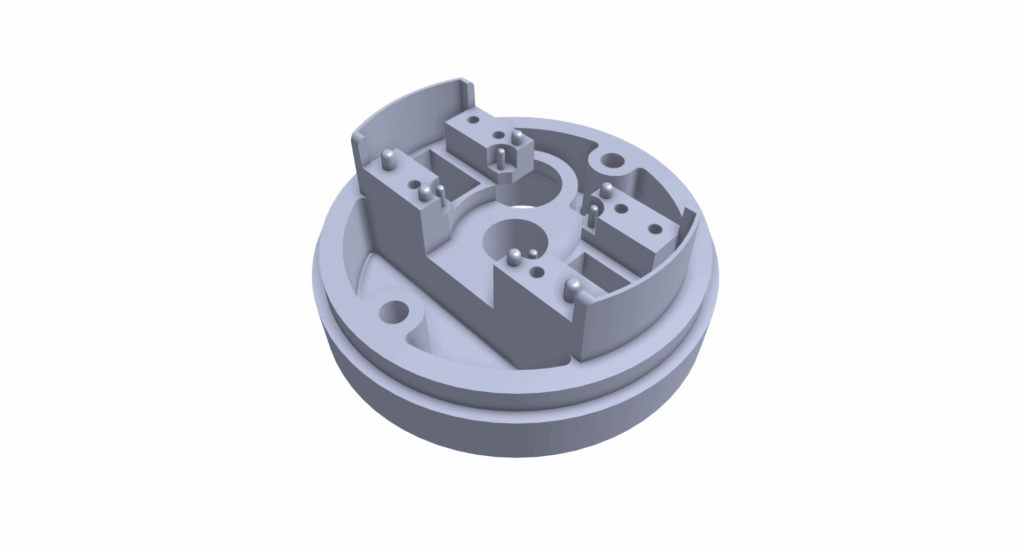
- Unhardened steel tooling: longer life than Aluminum, still somewhat faster and lower cost than hardened production steel
Can handle moderate blanking and small movement siding parts for undercuts and side openings. In special cases, larger motion side actions can be used in soft tooling, when consideration is given to bearings that support the motion and sealing is simple flat-face or very limited sliding faces.


In some cases these tools can be considered as pre-hardening volume production tools, allowing cavity feature changes to be relatively fast – but able to transition to full production standard tools by heat treatment and some post-heat operations to address precision loss resulting from heat treatment.
- Rapid tooling injection molding including additive-manufactured or additive-overcast cavity components: used when speed is the most critical, material constraints are lower, and geometry allows
When the cavity parts are silicone rubber, some moderate undercuts can be molded, with stretch extraction/ejection.
Typically these parts are vacuum or low pressure filled, with not real-production materials – often polyurethane resins, which offer good approximation/simulation of
- Bridge tooling: a mold intentionally built to produce early production volumes while the “final” production tool is built or while design is still stabilizing. This is a generalized term for any non-production or pre-production tooling
Equipment considerations
Low-volume runs may use:
- standard injection molding presses (often lower tonnage and moderated temperatures/pressures)
- simplified automation
- more manual handling and inspection – tolerable for for pilot volumes for low-volume and cost-insensitive products
The molding process
What changes in low-volume mostly isn’t the physics – it’s the practical setup:
- faster tool build and trial cycles
- more iterations, with a focus on steel-safe changes, inserts, swap-outs.
- tighter feedback loop between molding results and design updates
Lead time expectations
A major driver of low-volume tooling approaches is lead time to first-parts that can serve in real or close to real use. Simplified tooling and workflows can often produce parts far faster than full production tooling, which typically requires much longer procurement cycles to reflect hard materials, detailed and intricate surface textures, multiple validation and adjustment cycles, and multi-cavity or hot-runner optimization.
Benefits of low-volume injection molding
Reduced upfront tooling costs
Low-volume tools typically cost less because they use faster-to-machine materials, simpler mold bases, fewer cavities, and simplified (and therefore less robust) tooling structures.
Faster time to market
Instead of waiting months for hard, volume-capable tools, teams can get production-like parts quickly for validation and launch activities.
Design flexibility and iteration
Low-volume tools are less challenging and faster for design changes, making iteration more practical before locking-down a design.
It is good policy to make parts oversize in areas that may need adjustment – so that changes to the tool are metal OFF. ADDING metal to a tool is hard to the point of impractical in soft tools. Where a tool element needs metal added for a design iteration, this requires either full or partial replacement of the cavity. Cutting out and replacing sections is termed inserting and it is expensive and slows down fast programs.
Lower risk for new products
It’s a risk-management tool: validate demand and performance before committing to high-capex production tooling.
Supply chain flexibility
Small batch molding supports distributed manufacturing and reduces reliance on a single large production run.
Real or close to real materials, representative processes
Where prototype materials cannot deliver the robustness, cycle tolerance and spring behaviors – such as in four-dimensional parts – a soft tool can deliver extreme product performance knowledge that deeply informs a design.
Demand volatility mitigation
For uncertain demand, short run injection molding reduces overproduction risk and helps maintain on-demand inventory.
Drawbacks and limitations of low-volume injection molding
Low-volume injection molding is powerful, but it’s not always the best option.
Higher per-part cost
Compared with high-volume tooling, unit costs are usually higher due to:
- fewer cavities
- less automation
- shorter amortization window
- potential for more difficult setup and compromised molding parameters
Reduced tooling durability
Aluminum and soft steels won’t typically match hardened steel life. That’s fine for 100-5,000 parts, but will not suit long production programs without rebuild/transition planning.
Material limitations
Most common resins are feasible for molding in soft tools, but very abrasive, glass-filled, or high-temperature polymers can accelerate tool wear, pushing toward production tooling sooner.
Surface finish constraints
Textures and high-cosmetic requirements are possible, but deep textures or aggressive finishing can increase tool time and cost, obviating the low-volume, fast, low-cost objectives.
Throughput limitations
Low-volume programs will entail fewer (typically single) cavities, longer cycle times, and less automation, limiting production rates.
Less automation
Manual steps (handling, trimming, inspection) are common in pilot runs, especially when process windows are still being tuned. Flash is considerably higher risk as clamping force tolerance and blanking wear are sensitivities with soft tools.
When to use low-volume injection molding
Prototyping and functional testing
When the need is for prototypes that behave like production parts – material properties, weld lines, shrink, creep, chemical resistance – low-volume molding is the only practical route. Additive, and to a lesser extent vacuum cast prototypes are typically lookalikes, not behave-a-likes.
In some cases, CNC machined parts (in close-to real materials) CAN serve in performance evaluation – but the per-part cost can be hundreds of times the molded part price, quickly bringing rapid tooling cost into range, when more than a few parts are needed.
Pilot runs and market testing
Pilot run injection molding supports:
- early customer sampling
- field testing
- regulatory submissions (when applicable)
- packaging/assembly trials
Bridge production
Bridge tooling is ideal when:
- production tooling lead time is too long to equip the manufacturing setup and market samples needs
- early sales must start sooner than was planned
- design is mostly stable but not fully locked down
Niche markets and low-demand products
If the demand is in the hundreds or low thousands, low-volume molding may be the long-term solution, not just a bridge.
Equally, when very small volumes are required but cost sensitivity is low, soft tools offer a route to high quality parts that fully enable the product to be supplied, long term.
On-demand inventory management
Soft-tooled and low-volume injection molding supports on-demand inventory by enabling short, repeatable production runs, aligned to real demand. Instead of holding large finished-goods stock, manufacturers can produce small batches quickly, reduce warehousing costs, limit obsolescence risk, and respond flexibly to demand fluctuations or design updates.
Decision criteria
Low-volume injection molding is an effective solution when:
- the project demands production material performance and compromise undermines performance
- volumes are too high for 3D printing but too low for hardened tooling ROI
- there are anticipated design iterations
- time-to-market matters more than unit cost, at least in the earliest stages
Part design for low-volume injection molding
Standard injection molding design rules apply
Even in low-volume, the fundamentals still matter. Always adhere to seeking:
- consistent wall thickness to minimize shrinkage marking (sinks)
- appropriate draft angles are maintained, to deliver scuffing free and easy ejection and avoid excessive tool wear
- ribs are used instead of thick walls, to deliver rigidity without bulk
- correct gate location logic is used, to manage turbulence and weld lines
- controlled undercuts (slides, lifters, inserts) are minimized, as these slow down soft tooling almost as much as hard tooling – and present much more serious wear issues
Design flexibility in low-volume
Low-volume tooling often allows more iteration-friendly approaches:
- replaceable inserts for gates and features
- steel-safe dimensions that can be opened up later – metal off the tool (i.e. increased plastic volume) is easier than the opposite
- simplified actions when volumes don’t justify complexity
Tolerances
Low-volume molding can achieve close to production-grade tolerances, but:
- resin choice and shrink consistency matter – and packing pressures and operational temperatures can be challenging in soft tools
- tool material and thermal stability greatly affect fill-abrasive and tool-on-tool wear
- critical dimensions should be clearly called out and discussed early – and design tolerance should be maximized
DFM considerations
Low-volume is often where DFM feedback creates the most value because design changes are still practical and impactful.
It can be very valuable to integrate the design changes that make soft tooling both practical and reliable. This requires design team experience in the spectrum of tooling AND a supplier who can direct the soft-tool optimization of the product.
Low-volume vs High-volume injection molding
| Factor | Low-Volume Injection Molding | High-Volume Injection Molding |
|---|---|---|
| Typical quantities | ~100–10,000 | 50,000+ to millions |
| Tool materials | Aluminum, soft steel, rapid tooling | Hardened steel |
| Tooling cost | Lower upfront | Higher upfront |
| Lead time | Often <2–4 weeks (project-dependent) | Often 8–16+ weeks |
| Per-part cost | Higher | Lower at scale |
| Cavitation / automation | Often fewer cavities, less automation | Higher cavitation, more automation |
| Best for | Pilots, bridge, niche products, early production | Mature products with stable demand |
When to choose each
Choose low-volume when you need speed, flexibility, and real molded parts without full tooling investment. Choose high-volume when the design is locked, demand is proven, and unit economics matter most.
This presents as an essentially simple differentiation – however, real production and real world market entry rarely comply with this simple, binary analysis.
Seeking experienced suppliers and evaluating a range of tooling options, from soft to hard; from truly prototype to real-process, real-material before committing to a path.
Finding a low-volume injection molding supplier
Selecting the right supplier is absolutely central to successful sourcing of low-volume and soft-tooled injection molding programs. Unlike high-volume production, these projects depend on speed, flexibility, and informed decision-making, rather than tool longevity alone. The ideal supplier combines experience with Aluminum and soft-steel tooling, realistic DFM feedback, and clear communication during design iteration. Capability alignment matters more than scale, particularly in managing risk, controlling cost, and ensuring a smooth path from prototype and pilot runs to future production tooling.
What to look for in a low-volume supplier
- Proven experience with small batch injection molding and pilot programs
- Ability to build and run Aluminum and soft steel tools
- Willingness to support iteration and provide DFM guidance
- Ability to mold your intended production resin, not just “similar” material
- Clear quality approach and documentation appropriate to your industry
Evaluation criteria
- Tooling capabilities: Aluminum vs soft steel; insert strategies; typical lead times.
- Minimum part order quantities: ensure the supplier truly supports low volume.
- Communication and DFM support: can they handle direct technical feedback in real-time?
- Material capabilities: can they run filled resins, flame retardants, or specific grades required?
- Quality documentation: inspection plans, first article reporting, traceability as needed.
Customer pain points to be sensitive to:
- Instant-quote platforms, such as Xometry, can work for very simple parts, but these are typically useless when consultation is needed – are they a ‘vanilla parts only’ supplier?
- Continuity matters – the supplier who built the pilot tool has valuable learning to carry into production. Can they stay in-service to the project through the soft-to-hard tool transition.
- DFM feedback is often the difference between a clean pilot run and repeated tool rework. Are they proactive, supportive and experienced in the right methods?
Why platform choice matters
Low-volume projects benefit from a relationship-first model: direct supplier communication and capability matching. Jiga provides access to qualified low-volume molders while supporting quoting, communication, and quality assurance, helpful from pilot runs through production scaling.
Summary
Low-volume injection molding bridges the gap between prototyping and mass production. It enables production-quality parts in real materials with lower tooling cost and faster lead times than hardened steel molds. It’s ideal for functional validation, pilot programs, bridge production, niche demand, and on-demand inventory strategies. The right supplier – and the right communication model – matters, because iteration and DFM feedback are central to low-volume success.
It is in this regard that Jiga is the best possible interface, introducing the right suppliers and supporting the project by standing by the client throughout. Providing connection to vetted injection molding suppliers with low-volume capabilities and direct technical collaboration is the opening salvo that enables the win.