
As electronic systems grow faster and increase in power density, thermal management has become one of the more critical design challenges in product engineering. Cold plates – precision heat exchangers that use internal-galleried liquid cooling – are increasingly critical in keeping components in data centers, batteries and power controllers in electric vehicles (EVs), medical equipment, and power electronics within optimal operating temperatures.
From AI servers and robotics to defense systems and high-density EV batteries, cold plates represent the crucial link between performance and reliability. This guide explores what cold plates are, how they work, how they’re designed and manufactured, and where they’re used, ending with a look ahead to AI-driven design optimization and 3D-printed flow elements with convolute.
Key takeaways
- Cold plates are liquid-cooled heat exchangers that transfer heat from high-power components into circulating coolant.
- They work through direct thermal conduction and convective heat transfer into the working fluid, using a coolant flow path in close contact with the heat source.
- Key applications include data centers, EV battery packs, semiconductors, and medical imaging equipment.
- Common materials include Aluminum and Copper, chosen for thermal conductivity and corrosion resistance.
- Manufacturing methods include CNC machining, brazing, welding, and 3D printing, with new designs emerging from AI and robotic precision systems.
What is a Cold Plate?
A cold plate, also known as a liquid cold plate, is a heat exchanger designed to remove heat from high-temperature components such as power electronics, batteries, or processors. It works by transferring heat to a chilled fluid, which then circulates through internal channels or tubes, carrying the heat away from the source.
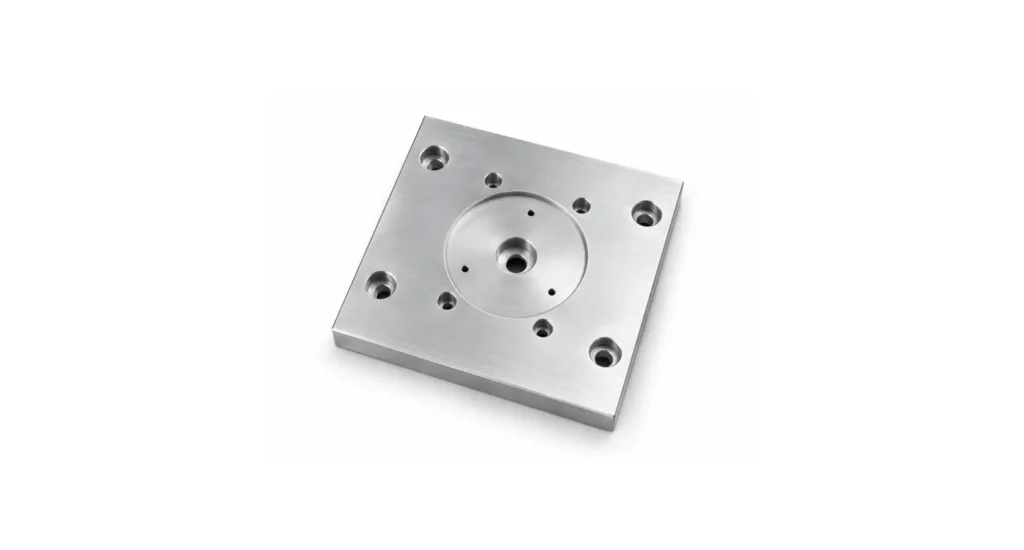
Typically made from Aluminum or Copper, a cold plate’s structure consists of a machined, cast, fabricated, or additive manufactured plate with embedded flow passages, sealed with covers or manifolds to contain the coolant. Alternatively – and increasingly – the plate can be a one-piece construct that is exclusively additive manufactured with increased (and potentially AI designed) convolution/turbulation in the self-contained internal galleries.
When mounted against a hot surface, it creates an efficient thermal bridge, allowing high heat fluxes to dissipate considerably faster than can be achieved by forced-convection air-cooled and radiant methods.
The coolant is most commonly water, often containing glycol mixtures for aggressive exterior chilling without freeze risk. It can also be a dielectric fluid, though this is less common. The liquid’s high specific heat capacity enables accelerated energy removal, commonly ten-plus times more effective than forced-air cooling.
These systems are integral in EV powertrains, semiconductor modules, and data-intensive computing environments, where precise temperature control extends equipment lifespan and stability.
How does a Cold Plate work?
Cold plates rely on basic conductive heat transfer to the plate and convective heat transfer from the plaster to the working fluid. Heat flows down the thermal gradient, from the hot component into the metal plate, then into the chilled circulating liquid, which carries it to a remote heat exchanger or radiator to be re-cooled.
Heat transfer principles
The efficiency of a cold plate is defined by Fourier’s Law (heat conduction through a solid) and Newton’s Law of Cooling (convective transfer from the solid wall to the contained fluid). The goal is to minimize thermal resistance through optimal contact area, controlled turbulence, and use of conformal thermal interface materials (TIMs) between the device and plate, to ensure good thermal coupling between otherwise unconnected bodies.
Coolant flow dynamics
Coolant travels through serpentine tubes, microchannels, or fin arrays, maximizing surface area and optimizing turbulence to enhance heat removal and rapidly disperse the heat into the working fluid. Flow rate and pressure drop are carefully balanced to deliver uniform temperature distribution, under design conditions.
In multi-device systems, parallel or manifolded channels ensure equal flow, while advanced designs use computational fluid dynamics (CFD) to fine-tune internal paths for consistent performance and uniformity of cooling effect.
Avoidance of both hot and excessively cold spots in a system can be a critical durability and device performance factor.
Thermal conductivity factors
Material selection directly affects performance.
- Copper (≈400 W/mK) provides optimal thermal conductivity but is heavier and expensive
- Aluminum (≈200 W/mK) offers lighter weight, lower cost, and easier machining.
- Surface treatments, isolation by (electrical) insulators and anodizing improve direct and electrolytic/galvanic corrosion resistance in mixed-metal systems. These can have a suppressive effect on thermal conductivity and must be considered with care.
Types of Cold Plates
Various internal structures offer trade-offs between manufacturability, performance, and cost.
Tube-based Cold Plates
The most common type, these embed Copper or stainless-steel tubes into a machined Aluminum slab. Ideal for moderate heat loads, tube-based plates are cost-effective, simple to fabricate, and compatible with various coolants.
Advantages:
- Low manufacturing cost
- Robust and repairable
- Suitable for large surface areas
Limitations:
- Uneven temperature distribution under localized heat sources
- Lower performance for high heat flux applications
Channel-based Cold Plates
These use machined or extruded channels in the plate body for control of coolant flow. Flow patterns can be serpentine, parallel, or manifolded (depending upon manufacturing method), offering more uniform temperature profiles.
Applications suited to this type are power electronics, EV inverters, and industrial drives.
They deliver excellent performance at higher heat densities with manageable pressure drops.
Pin-Fin Cold Plates
Pin-fin designs integrate densely packed metal pins (round or hexagonal) inside the flow chamber. These structures dramatically increase surface area and turbulent mixing, optimizing heat transfer efficiency from metal to fluid.
Applications include high-performance computing (HPC), laser systems, and semiconductor modules.
They require higher manufacturing cost and potential for pressure drop increases the flow-effort required for optimal heat extraction.
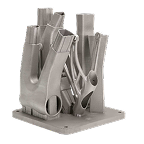
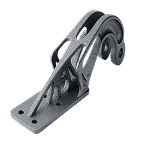
3D-Printed Cold Plates
Additive manufacturing allows complex internal geometries that are impossible from any other fabrication process. These include lattice structures, micro-channels, integrated manifolds turbulator features
Advantages:
- Optimized thermal pathways with minimal material use
- Lightweight, compact structures for aerospace and EVs
- Rapid prototyping and customization
A 3D-printed liquid cold plate can deliver up to 30% higher thermal efficiency with 40% weight reduction, when compared to a design suited to more established methods.
An introduction to Cold Plate design
The design of a cold plate is a layered and multidisciplinary process that draws upon knowledge of thermodynamics, material properties, flow behavior, and pivots around manufacturability.
At its heart, a cold plate functions as a liquid-cooled heat exchanger, transferring heat from high-power (and at overheat risk) electronic, process or mechanical components into a circulated and externally chilled coolant. The design process begins with defining the heat load, temperature limits, and coolant type, which parameters drive the required surface area, flow rate, and internal geometry.
Materials selection
Material choices are equally critical. Aluminum is the most common due to its conductivity, weight, and low cost, while Copper is preferred for high-heat or compact systems where superior thermal performance justifies higher price. Stainless steel or Nickel alloys are used for corrosive or deionized coolants, despite these alloys offering relatively poor thermal conductivity.
Flow path design, heat transfer and AI
Flow path design in cold plates governs how the working fluid travels through channels, manifolds, and ports, determining pressure drop, affecting heat extraction efficiency, and system stability.
Traditional flow paths typically follow straight or serpentine channels with capping plates, simplifying manufacturability, with a potential performance cost.
Heat transfer is fundamentally driven by surface contact, turbulence promotion for hot/cold mixing, and thermal conductivity. Increasing wetted surface area, introducing controlled turbulence, and ensuring uniform distribution are key to preventing hotspots and improving reliability, particularly in high-power electronics, aerospace actuation, or chemical process equipment.
AI-driven design tools are increasingly reshaping how engineers approach these geometries. Instead of manually optimizing a selected few parameters, AI can iterate through thousands of possible internal structures, evolving lattice, branching, or biomimetic flow channels that maximize heat transfer while minimizing pressure loss.
These structures are typically too complex for subtractive machining but become feasible, or even simple, through additive manufacturing, especially in metals such as AlSi10Mg, Ti-6Al-4V, or Copper alloys.
The implication is a shift from “design for manufacturability” to “manufacturability enabling optimal design.” By integrating AI-generated geometries and additive manufacturing, engineers can produce compact, lightweight, high-performance cold plates that greatly exceed ‘normal’ performance and weight expectations.
Cold Plate Morphology/Construction
Cold plates are constructed using a range of configurations – tube-based, channel-based, or pin-fin designs.
- Tube-based plates embed serpentine or parallel tubing within a metal body, offering simplicity and robust performance for moderate heat fluxes.
- Channel-based designs are machined or etched directly into the plate. This allows precise control of coolant flow paths, improving uniformity and thermal efficiency.
- For maximum surface area and turbulence, pin-fin structures which are either machined, bonded, or additively manufactured create localized vortices that enhance convective heat transfer.
Sealing and structural integrity are critical to the function – leakage can be catastrophic. Designing for internal pressure, thermal expansion, and possible galvanic corrosion between dissimilar metals will create a good result. O-ring grooves under screw compression, brazed joints, or welded seams are chosen based on pressure rating and maintenance expectations
Liquid cold plate design increasingly employs computational fluid dynamics (CFD) and AI-driven optimization to refine flow distribution, minimize pressure drop, and reduce thermal gradients. 3D printing enables complex internal geometries that were previously impossible, pushing thermal performance and design freedom beyond traditional limits while maintaining manufacturability and reliability.
Cold Plate manufacturing methods
Each manufacturing approach affects performance, precision, and cost.
| Manufacturing Method | Typical Tolerance | Cost Level | Key Advantages | Best Applications |
|---|---|---|---|---|
| CNC Machining | ±0.05 mm | Medium | High precision, flexible geometry | Prototypes, custom liquid cold plates |
| Brazing / Welding | ±0.1 mm | Medium–High | Strong joints, good for multi-channel assemblies | Power electronics, EV battery cooling |
| Vacuum Brazing | ±0.05 mm | High | Clean joints, no flux residue, excellent reliability | Aerospace, defense, medical |
| Additive Manufacturing (3D Printing) | ±0.1 mm | High | Complex internal features, weight optimization | 3D printed cold plates, next-gen EVs |
| Robotics / AI-Integrated Manufacturing | ±0.02 mm | Variable | Adaptive process control, predictive quality assurance | Mass customization, smart production lines |
CNC Machining for Cold Plates
CNC machining remains the most common fabrication process. It offers excellent repeatability, surface finish, and integration with standard fittings. Multi-axis CNC systems allow serpentine or embedded tube designs with tight tolerances for high-performance applications.
Brazing and Welding techniques
Brazing joins multiple plate sections or embeds tubes in plates, ensuring leak-proof assemblies. Vacuum brazing, in particular, provides oxide-free, high-strength joints ideal for mission-critical systems like satellites or EV traction inverters. Laser and electron-beam welding also feature in precision joining of thin-walled components.
Additive Manufacturing (3D Printing)
3D printing introduces previously inconceivable design freedom. Engineers can create custom liquid cold plates with topology-optimized flow channels, integrated manifolds, and minimal joints, reducing potential leakage paths. Materials include Aluminum alloys (AlSi10Mg) and Copper-based powders for maximum thermal performance.
Vacuum Brazing
Vacuum brazing eliminates flux and contaminants, while ensuring uniform heat distribution throughout the entire assembly. This process is common in cold plates used in medical imaging systems, defense avionics, and semiconductor tools, where cleanliness and reliability overwhelm cost concerns.
Robotics and AI
Effective cold plate manufacturing is increasingly guided by automation and AI/ML-driven quality control. Machine vision systems verify joint integrity, while predictive AI models and deep analysis of prior products optimize brazing temperatures and CNC toolpaths for consistent precision.
Jiga works with global suppliers who leverage these, and other technologies to achieve repeatable quality, reduced lead times, and world-leading design flexibility, supporting both prototype and production-scale orders.
Applications of Cold Plates
Data center and server cooling
High-density processors generate intense localized heat loads. Cold plates circulate coolant through racks and chip modules, reducing thermal concentrations and increasing uptime. Liquid cooling considerably reduces energy use, compared to air conditioning.
Electric vehicle battery thermal management
EV battery packs rely on deeply embedded cold plates to regulate temperature and prevent thermal runaway. Integrated liquid channels ensure uniform temperature across cell clusters, extending battery life and improving fast-charge performance by allowing conditions that run closer to hard thermal limits.
Power electronics and semiconductors
In inverters, converters, and IGBTs, cold plates manage power losses that would otherwise degrade performance. Their compact design allows integration within control modules, maintaining junction temperatures below safe limits while enabling more aggressive device use.
Medical equipment cooling
MRI machines, CT scanners, and diagnostic lasers depend on cold plates for stable temperature control, key to many imaging technologies. Vacuum-brazed Copper cold plates provide consistent cooling with non-magnetic alloys and bio-safe fluids.
Aerospace and Defense applications
Cold plates in radar, satellite payloads, and avionics must handle extreme conditions with minimal mass. Advanced, tuned conductivity alloys and additive-manufactured geometries provide high thermal performance with reduced weight penalties.
Future trends in Liquid Cold Plate manufacturing
The next period is set to drive rapid innovation in AI-optimized thermal design, additive manufacturing, and robotic production systems. Engineers increasingly use CFD, digital twins and data-ocean based machine-learning models to predict flow behavior and thermal efficiency before fabrication.
3D-printed liquid cold plates are expected to become standard for compact, high-power electronics, as process and material cost see downward pressure. Novel and tailored dielectric nanofluids are set to increase performance and reduce cold plate size/weight/cost by boosting thermal performance.
At Jiga, we collaborate with manufacturing partners adopting robotics, AI, and advanced metrology to enhance product consistency and shorten design-to-delivery cycles. These advances enable custom liquid cold plates tailored precisely to your thermal performance and packaging requirements.
Frequently Asked Questions
What is the difference between a cold plate and a heat sink?
A heat sink transfers heat to surroundings and atmosphere through radiant/convective fins, while a cold plate near-directly applies liquid coolant to carry heat away more effectively, at higher power densities.
How much heat can a cold plate dissipate?
Depending on design, size and coolant flow rate, a cold plate can dissipate anywhere from a few Watts to several kilowatts. High-performance pin-fin or 3D-printed versions can manage even greater thermal loads.
How important is choosing the right fluid for cold plates?
Coolant selection affects corrosion resistance, thermal performance, and maintenance. Water-glycol mixtures are typical, but dielectric fluids are used in electronics to prevent short-circuiting, in the event of leakage.
How do I choose the right liquid cold plate for my application?
Consider heat load, coolant type, flow rate, pressure drop, material compatibility, and available space. Consulting with a qualified manufacturer through platforms like Jiga improves the process in delivering a design suited to your specific system.
What is the typical lifespan of a cold plate?
Properly maintained cold plates can last indefinitely, depending on fluid quality, corrosion control, and environmental exposure. Regular inspection and flushing extend service life, as do corrosion suppression additives and sacrificial anode integration.
Are 3D-printed cold plates as effective as traditionally manufactured ones?
Yes, when properly designed and post-processed, 3D-printed cold plates can outperform conventional designs due to optimized geometries and lower joint counts, though they typically carry higher initial costs.