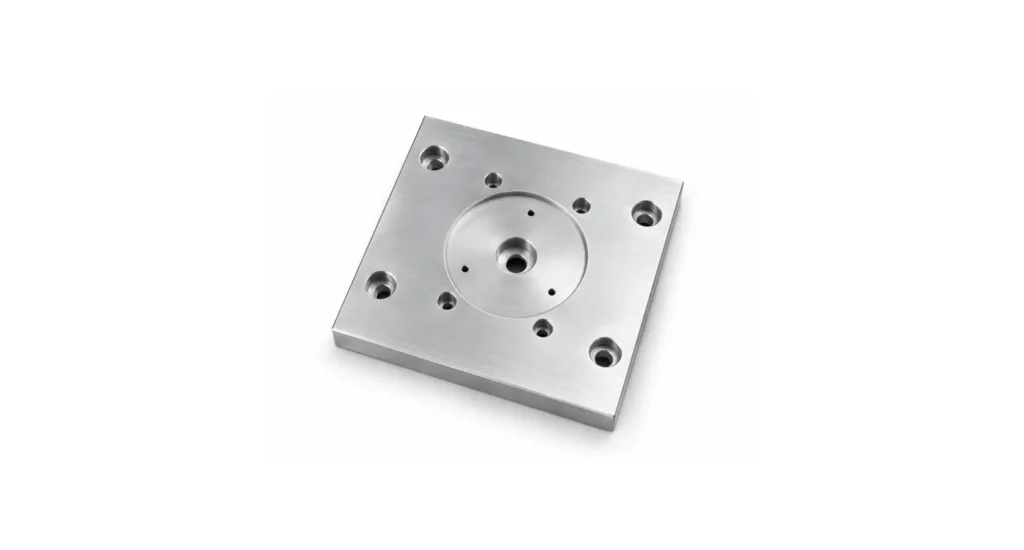

Waterjet cutting is viewed as one of the more versatile extractive manufacturing options available. While CNC milling has long been the go-to process for precision machining, many engineers underestimate how capable modern waterjet systems have become, especially for cutting thick, hard, or heat-sensitive materials.
In this guide, we will break down; how waterjet cutting serves; where it excels; its limitations; and where it compares favorably to CNC milling. Whether you’re a production engineer, product designer, or procurement manager, this article will assist in developing confidence in determining exactly when waterjet is the right choice for your project. Spoiler alert: it’s more often than most potential users imagine.
Key takeaways
- Waterjet part-extraction is a cold-cutting technology using high-pressure water (with or without abrasives), producing no heat-affected zones.
- Waterjet cutting excels at processing heat-sensitive, brittle, optically reflective, or difficult-to-machine materials, as well as intricate non-contact shaping.
- CNC milling typically achieves tighter tolerances, but waterjet eliminates all risk of thermal distortion and mechanical cutting forces.
- Waterjet can cut virtually any material but will typically be too slow for high-volume and not serve well in tight-tolerance part extraction.
- Modern 5-axis waterjet systems enable beveled edges, complex contours, and 3D cutting in a single setup.
What is waterjet cutting?
Waterjet cutting uses an ultra-high-pressure stream of water – typically between 40,000 and 90,000 PSI – to cut materials by fluid impact erosion rather than by heat or mechanical shearing. The water is forced through a small sapphire, diamond, or carbide orifice, creating a highly focused jet.
There are two primary types:
Pure waterjet cutting
- Uses only water
- Ideal for soft or flexible materials with low to zero water absorption capacity, such as plastics, rubber, foam, textiles, food products.

Abrasive Waterjet Cutting (AWJ)
- The water jet carries hard, abrasive garnet particles into the stream
- Enables cutting of metals, ceramics, stone, glass, composites, and hardened materials

The principle is fundamentally kinetic: the jet transfers energy to the material, eroding it without bulk heating and without creating microstructural changes. The energy transfer creates highly localized heat and pressure induced distortion that fractures atomic bonds and shears crystal planes.
Because it is a cold process, waterjet cutting avoids any generalized heating, macro thermal-expansion induced warping and heat-induced metallurgical/morphological changes.
How does waterjet cutting work?
The waterjet cutting process uses a pressurized jet, delivered through a sapphire or carbide nozzle, that creates a narrow and smooth, cylindrical and laminar jet. A high-pressure pump delivers water through this small, hard orifice (0.004″ – 0.015″), creating a stream that exits at around Mach 3. For abrasive cutting, added garnet powder massively increasing the erosive capability.
Applications of waterjet cutting
Waterjet cutting is used across all industries where precision, versatility, and material integrity are critical. Below are some of the most common applications.
Aerospace and defense
Aerospace manufacturers value waterjet for cutting:
- Titanium, Magnesium and Aluminum structural components
- Composites (carbon fiber, G10, Kevlar)
- Honeycomb composited structural sheets
- Heat-treated alloys that must retain properties
Waterjet preserves the mechanical performance of high-value materials.
Automotive manufacturing
Applications include:
- Gaskets and insulation materials
- Interior components
- Body panels
- High-strength steel structures
- Prototyping
For EVs, waterjet is increasingly used for battery insulation foams and specialty metals.
Electronics and semiconductors
Waterjet is ideal for:
- PCB substrates
- Gasket materials
- RF shielding components
- Heat-sensitive polymers
It avoids thermal effects that could damage electronic components.
Architectural and artistic applications
Waterjet provides otherwise hard to achieve flexibility in cutting:
- Stone
- Tile
- Glass
- Decorative metals
- Custom signage
Designers choose it for intricate patterns and smooth, zero post-process edges.
Food and pharmaceutical industries
Pure waterjet cutting is used for:
- Clean food slicing (no contamination)
- Pharmaceutical components requiring burr-free edges
Jobbing shops and prototyping
Waterjet performs commercially in low-volume and high-mix environments where:
- Material variety is high
- Tooling costs must remain low
- Quick prototyping is essential
CNC waterjet cutting machines: Components and capabilities
A modern CNC waterjet cutting machine is a sophisticated system that integrates ultra-high-pressure pump technology, precision motion control of axes, and advanced cutting head design. The core components include:
Pump systems and pressure generation
Two pump types dominate the industry:
Hydraulic intensifier pumps
- Higher pressure, reliable for heavy materials
- Ideal for thick metal cutting
Direct-drive electric pumps
- More energy efficient than intensifiers, delivering lower pressures
- Better suited to light/medium-duty, thin materials
Pressures range from 40,000 to 90,000 PSI, affecting cutting speed and kerf width.
CNC control and CAD/CAM integration
Waterjet machines use directly analogous G-code workflows to other CNC machine formats. CAD files feed into CAM software that controls:
- Feed rate
- Piercing strategies
- Angle control (in 5-axis systems) for optimized taper-compensation in the kerf
- Material or head positioning in multiple axes of cooperative motion
Cutting head assemblies and nozzle technology
Key elements include:
- Sapphire or diamond orifices
- Carbide mixing tubes
- Abrasive metering systems
- Automatic height sensing
- Anti-taper features – analogous to collimation in a laser to minimize divergence after the nozzle
These components influence cut precision, kerf width, resultant cut-face angle precision, cut and traverse speeds, and operating cost.
5-Axis waterjet cutting
The most capable, 5-axis motion control systems enable:
- Beveled and weld-prepped edges
- Complex contours
- 3D shapes
- Variable angle cuts
These advanced capabilities significantly expand waterjet’s usefulness for aerospace, automotive, and custom manufacturing.
Waterjet cutting vs Alternatives
The idea that waterjet is the single best cutting method is at best misleading. In practice, modern manufacturing draws on a spectrum of precision cutting technologies, each optimal for specific materials, geometries, tolerances, production volumes, and cost requirements.
Waterjet’s versatility comes with some severe tradeoffs: slow cutting speeds in thick materials, higher operating costs due to abrasives, and limitations in tight tolerances. Conversely, thermal processes like laser and plasma offer exceptional speed but introduce thermal distortion or metallurgical and morphological changes. Mechanical processes such as CNC milling or sawing boast tight tolerances and surface finishes but typically fail with non-metallic composites, soft materials, or intricate internal contours without expensive additional fixturing or cryogenic machining.
Tables below provide a balanced examination of six major alternatives to waterjet cutting:
Waterjet cutting vs Laser cutting
| Criteria | Waterjet Cutting | Laser Cutting (Fiber/CO₂) |
|---|---|---|
| Cutting Mechanism | High-pressure water mixed with abrasive erodes material through mechanical removal | Focused laser beam melts/vaporizes material through thermal energy |
| Heat-Affected Zone (HAZ) | None; fully cold process. Ideal for heat-sensitive materials. | Present. Minimal in fiber lasers but still measurable; can affect metallurgy in some alloys. |
| Best Materials | Metals, composites, stone, glass, ceramics, plastics, laminates; works on nearly anything. | Metals (steel, stainless, aluminum), some plastics and organics; poor for reflective materials unless using specialized fiber lasers. |
| Typical Tolerance | ±0.1–0.25 mm (tighter with taper compensation and fine-cut settings). | ±0.025–0.1 mm (generally more precise than waterjet) |
| Edge Quality | Smooth, burr-free, no microcracking; slight striation on thicker sections. | Very clean edges; may show minor dross on thicker plate depending on gas and power settings |
| Thickness Capability | Excellent— cuts up to 200–300 mm depending on material and abrasive | Best for thin to mid-thickness sheet; 0.5–25 mm typical. Up to 40–50 mm on high-power systems. |
| Cutting Speed | Slower, especially on thick material; speed decreases significantly as thickness increases. | Extremely fast on thin-to-medium sheet; significantly higher throughput | Setup Time | Short; CAD/CAM load and edge prep minimal. | Short; automated height control and nesting systems streamline setup. |
| Kerf Width | Wider (~1.0–1.5 mm with abrasive nozzle) | Very narrow (~0.1–0.4 mm) |
| Material Distortion Risk | None—no heat input | Moderate; thermal bowing or warping possible on thin sheets |
| Consumables | Abrasive media, mixing tubes, orifices, pump maintenance. | Assist gas (O₂, N₂), lenses, nozzles |
| Operating Cost | Higher per hour due to abrasive consumption and pump wear | Lower per hour; electricity + gas dominate cost |
| Complex Geometry Capability | Excellent for non-metals, thick parts, and internal contours without piercing issues. | Excellent for thin metals, very small features possible, but thermal process limits some geometries |
| Environmental Considerations | Spent abrasive disposal and large water usage | Fume extraction and filtration required; minimal waste material |
Waterjet cutting vs CNC milling
| Criterion | Waterjet Cutting | CNC Milling |
|---|---|---|
| Cutting Mechanism | High-pressure water or abrasive jet erodes material | Rotating cutting tool removes material (mechanical) |
| Heat-Affected Zone | None, cold-cutting | Moderate to high, depending on speed and material |
| Best Materials | Metals, composites, glass, stone, plastics | Metals, plastics, wood, composites |
| Typical Tolerances | ±0.1–0.25 mm | ±0.01–0.05 mm |
| Edge Quality | Smooth, minor striations | Very smooth, may require finishing depending on tool |
| Thickness Capability | Up to 150 mm+ (depending on material) | Limited by tool rigidity and reach |
| Setup Time | Low, digital tooling | Moderate, requires fixturing and tool selection |
| Cutting Speed | Moderate | High for thin materials, slower for deep cuts |
| Tool Wear | Minimal, nozzle replacement only | Tool wear significant, requires periodic replacement |
| 3D Capability | 5-axis bevel cutting possible | Multi-axis 3D milling possible but complex |
| Material Waste | Minimal | Higher chip generation |
| Cost per Part | Low-medium | Medium-high depending on complexity |
| Volume Suitability | Low to medium | Medium to high |
Waterjet cutting vs Plasma cutting
| Criterion | Waterjet Cutting | Plasma Cutting |
|---|---|---|
| Cutting Mechanism | High-pressure water or abrasive jet | High-temperature plasma arc melts material |
| Heat-Affected Zone | None | Moderate to high |
| Best Materials | Metals, composites, plastics, glass | Conductive metals, steel, aluminum, copper |
| Typical Tolerances | ±0.1–0.25 mm | ±0.5–1.0 mm |
| Edge Quality | Smooth | Rough, may require grinding |
| Thickness Capability | 150 mm+ | Up to ~50 mm (industrial) |
| Setup Time | Low | Moderate |
| Cutting Speed | Moderate | High |
| Material Waste | Minimal | Moderate |
| Safety Considerations | Minimal, high-pressure water precautions | High, heat and sparks |
Waterjet cutting vs Wire EDM
| Criterion | Waterjet Cutting | Wire EDM |
|---|---|---|
| Cutting Mechanism | High-pressure water or abrasive jet | Electrical discharge between wire and workpiece |
| Heat-Affected Zone | None | Minimal, localized |
| Best Materials | Metals, composites, stone, plastics | Hardened metals, tool steels, exotic alloys |
| Typical Tolerances | ±0.1–0.25 mm | ±0.005–0.02 mm |
| Edge Quality | Smooth, minor striations | Very smooth, no mechanical stress |
| Thickness Capability | Up to 150 mm+ | Typically 0.1–300 mm depending on machine |
| Cutting Speed | Moderate | Slow for thick parts |
| Setup Time | Low | High, requires fixturing and dielectric preparation |
| Volume Suitability | Low to medium | Low to medium |
| Cost | Medium | High |
Waterjet cutting vs Punch press/Turret punching
| Criterion | Waterjet Cutting | Punch Press / Turret Punching |
|---|---|---|
| Cutting Mechanism | High-pressure water or abrasive jet | Mechanical punching with dies |
| Heat-Affected Zone | None | None |
| Best Materials | Metals, composites, plastics | Sheet metals, thin materials |
| Typical Tolerances | ±0.1–0.25 mm | ±0.1–0.3 mm |
| Edge Quality | Smooth | Slight deformation or burr |
| Thickness Capability | Up to 150 mm+ | Typically 0.5–6 mm |
| Cutting Speed | Moderate | Very high for thin sheets |
| Tool Wear | Minimal | Die wear, frequent maintenance |
| Volume Suitability | Low to medium | High-volume sheet production |
| Design Flexibility | High, complex curves | Limited to die shapes |
Waterjet cutting vs Traditional sawing
| Criterion | Waterjet Cutting | Traditional Sawing |
|---|---|---|
| Cutting Mechanism | High-pressure water or abrasive jet | Mechanical blade removes material |
| Heat-Affected Zone | None | Moderate to high, depending on blade and speed |
| Best Materials | Metals, composites, plastics, stone | Metals, wood, plastics |
| Typical Tolerances | ±0.1–0.25 mm | ±0.2–0.5 mm |
| Edge Quality | Smooth | Rough, may require finishing |
| Thickness Capability | 150 mm+ | Limited by blade length and rigidity |
| Cutting Speed | Moderate | Moderate to high for thin materials |
| Tool Wear | Minimal | Blade wear significant |
| Volume Suitability | Low to medium | Low to medium |
| Material Waste | Minimal | Moderate |
Choosing the right cutting process: A decision framework
Choosing a cutting method requires an holistic assessment of material characteristics, part geometry, production volume, tolerance requirements, and operational constraints.
Start by evaluating the material type and thickness.
- Waterjet excels with metals, composites, plastics, soft materials, and stone, including very thick sections.
- Laser cutting is efficient for thin metals
- Wire EDM is ideal for hardened alloys requiring extreme precision.
Geometry and feature complexity are next:
- Intricate curves, beveled edges, or internal cutouts may favor waterjet or EDM.
- Simpler profiles can be produced efficiently with CNC milling or punching.
- Orthogonal and straight cuts can favor sawing.
Tolerance and surface finish are critical:
- Wire EDM and CNC milling provide sub-0.05 mm tolerances.
- Waterjet typically offers ±0.1–0.25 mm.
Thermal sensitivity can be a critical factor:
- Waterjet’s cold cutting avoids heat-affected zones, protecting heat-treated metals or composites.
- Laser and plasma can introduce distortion and extensive HAZ.
Production volume affects cost-effectiveness:
- High-volume parts often benefit from turret-punch or custom-punch operations.
- CNC milling is often competitive in medium volume.
- Low to medium-volume or rapid prototyping favors waterjet or flexible CNC operations.
Operational considerations, such as equipment availability, setup complexity, tooling costs, and operator skill, can considerably influence process selection.
Combining waterjet and other processes: Hybrid workflows
In many manufacturing environments, the most efficient workflow uses both waterjet cutting and CNC milling, where each is more appropriate. Waterjet is excellent for creating near-net-shape blanks, CNC milling then takes over for finer details.
Near-net-shape cutting with waterjet
Cutting the raw material to a ready-to-machine shape reduces:
- Roughing time
- Tool wear
- Fixturing complexity
Precision finishing - typically with CNC milling or spark erosion
After waterjetting, milling and spark erosion handles:
- Final tolerances
- Surface finish
- 3D feature areas impossible to achieve with waterjet
- Internal features and pockets
Workflow optimization strategies
- Use waterjet preferentially for thick or intractable materials
- Apply CNC milling or spark erosion only where increased precision or complex 3D features are required
- Maintain consistent datums throughout both operations
This hybrid approach often results in lower costs and faster delivery. It can open up design opportunities that are inaccessible or impractical by waterjet alone.
Precision waterjet cutting: Capabilities and limitations
Waterjet cutting offers excellent precision for a cold-cutting method, typically achieving ±0.1–0.25 mm accuracy and ±0.05 mm repeatability. CNC milling tolerances are ±0.01 mm or better.
Tolerance capabilities and factors
Waterjet accuracy depends on:
- Material thickness
- Cutting speed
- Abrasive flow quality
- Nozzle wear
- Machine rigidity
Taper and edge quality considerations
Waterjet produces slight taper in the cut, as the jet inevitably expands and diffuses after exit from the nozzle. Advanced machines use in-nozzle ‘collimation’ and tilt-axis taper compensation to correct this automatically.
Surface finish characteristics
Edges may show striations – linear ridges aligned with the jet; however, there will be:
- No burrs
- No heat distortion
- No microcracks
Waterjet surfaces are often considered of high enough grade for ‘engineering’ end uses but can require secondary finishing for cosmetic or precision needs.
Material compatibility and selection for waterjet cutting
Waterjet cutting is one of the most versatile precision-cutting technologies available, capable of processing an astonishing variety of materials without introducing thermal or mechanical damage.
This makes it especially valuable in cutting soft and hardened metals, composites, glass, stone, plastics, foams, and elastomers. Material properties – particularly hardness, thickness, density, and brittleness – directly influence cutting parameters such as pressure, abrasive flow rate, nozzle size, and traverse speed. Hard, dense materials generally require slower cutting speeds and higher abrasive volume, while softer or more flexible materials benefit from pure waterjet cutting to avoid overcutting or fiber pull-out.
Pure waterjet cutting is ideal for soft materials such as rubber, foam, textiles, gaskets, and food products, where the goal is a clean edge without embedding hard particles. Abrasive waterjet cutting is required for metals, glass, ceramics, and most composites, delivering high edge quality and tight tolerances with no thermal stress.
Material thickness greatly influences speed traverse speeds – thin Aluminum may cut at 3,000–4,000 mm/min, while thick stainless steel will cut at considerably lower feeds.
With thoughtful parameter tuning and the most appropriate abrasive, waterjet cutting delivers consistent, high-quality results across virtually all engineering materials.
Metals: Stainless steel, aluminum, and alloys
Waterjet cutting of metals offers major advantages over all other processes, due to the absence of HAZ and the ability to maintain crystalline and hardening integrity.
- Stainless steel benefits from clean, burr-free edges without the oxidation or dross
- Aluminum cuts extremely well, with control of standoff distance and traverse speed.
- Hard alloys (Inconel, tool steel, hardened steels) require slower speeds and higher abrasive concentrations.
Typical tolerances range from ±0.1–0.25 mm, tightening with taper compensation and thorough/experienced parameter control.
Glass and brittle materials
Glass, ceramics, stone, and other brittle materials demand more careful control of pierce pressure and approach speed, to prevent microcracking. Optimized lead-in paths help maintain structural clarity and avoid chipping. The moment of opening the surface is where the greatest risk of failure of the material is prevalent. Waterjet’s cold process avoids thermal fractures.
Rubber and soft materials
Soft materials, including rubber, foam, silicone, elastomers, textiles, and various composite gasket sheets, are best processed using pure waterjet cutting. High traverse speeds are possible. Consistent fixturing and stable water support improve dimensional accuracy on compressible materials.
Design considerations for waterjet cutting
Good design practices ensure high-quality results and cost-efficient production. Sensitivity to the strength, weaknesses and material issues of the process will enhance outcome quality and can often speed processing and reduce costs.
Kerf compensation and nesting strategies
Kerf width varies (typically 0.8–1.2 mm). CAD files should account for:
- Kerf offset
- Smart nesting to minimize waste and fully utilize the operational space
- Lead-in/lead-out paths for pierce points, to reduce start-moment impacts on component quality

Thickness-related design factors
Thicker materials demand consideration in designing to account for:
- Greater taper (or capability/space for taper compensation)

- Slower cutting
- Larger minimum feature sizes – particularly as taper compensation becomes highly challenging around fine features
Feature size and geometry limitations
When designing components for waterjet cutting, feature size and geometry must allow for the kerf width, jet flare, and minimum web thickness the process can reliably produce.
- Very fine internal corners or narrow slots can lose definition because the jet accelerates and decelerates through tight curves.
- Typically, inside radii should match or exceed the stream diameter, and slender features should be avoided if they rely on unsupported material.
- Clean, continuous contours and generous radii help maintain accuracy, edge quality, and dimensional repeatability
Summary
Waterjet cutting offers hard-to-equal versatility across a wide spectrum of materials, thicknesses, and geometries. It is especially valuable when a cold-cutting, no-HAZ method is required. While CNC milling remains superior for tight tolerances and detailed 3D features, waterjet is a highly effective complement.
At Jiga, we connect our clients with highly qualified manufacturers specializing in all forms of machining/cutting, with a strong interest in waterjet cutting, CNC machining, and hybrid workflows. With rapid connection to appropriate suppliers, fast quoting, verified partners and rapid comms, and guaranteed quality, Jiga streamlines how engineers source custom parts.