
Laser welding, like all of the common bulk welding processes (TIG, MIG, SMAW etc) is a fusion welding process. It uses a focused, high-power laser beam to melt material at a contact point/line, allowing the melt-pool to integrate the joint. The addition of filler material is optional, unlike MIG and SMAW (shielded metal arc, or stick welding), which rely on the filler as the energy delivery mechanism.
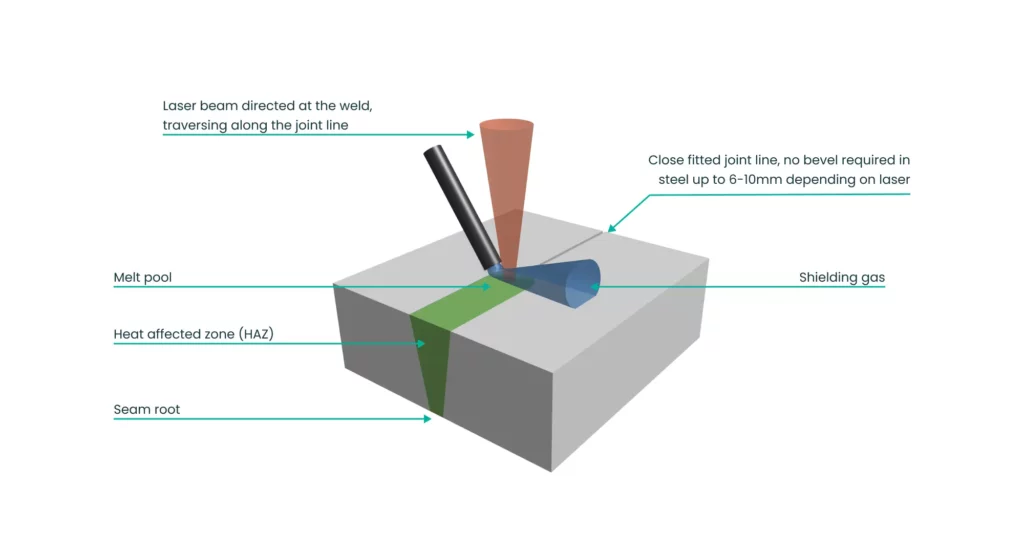
Unlike MIG, SMAW, or TIG welding, energy is delivered as a coherent and focussed light-beam, not an electrical arc. The result is the ability to produce narrow, deep welds with a minimal heat-affected zone (HAZ). This typically results in much lower distortion and significantly higher welding speeds than more conventional, arc energy processes which do not direct the energy so precisely.

As a result of the conservative application of energy, and more localized intensity, laser welding can process as much as three to five times faster than TIG welding, while maintaining tighter dimensional stability and more precise control of the melt-pool.
The process is widely used in automotive, aerospace, medical, electronics, battery, and precision industrial manufacturing. It is ideal wherever repeatability, moderated heat input, and automation compatibility allow for amortization of the higher equipment costs.
Laser welding is particularly effective on thin-to-medium gauge material, small assemblies, precision housings, and hermetic seals, due to lower net-energy levels. It is also well suited to highly automated production lines, as its repeatability and typical maintenance down-time are excellent.
This guide explains how laser welding functions, the differentials between conduction and keyhole welding, the range of suitable materials, and appropriate joint types. We analyze how laser welding compares with MIG and TIG, the limitations engineers need to design around to accommodate it, and how to evaluate the capabilities and service standards of laser welding suppliers.
Key takeaways
- Laser welding can produce narrow, deep welds with very low heat input and transverse conduction. The heat-affected zone is generally 10% of MIG welds, on otherwise identical joints, reducing the weld-region disruption of the surrounding crystalline structure and bulk properties of the joined parts.
- The two primary process modes – conduction and keyhole welding – are appropriate to different thicknesses and joint requirements. Selecting incorrectly is a common specification mistake.
- Laser welding can be as strong as, or stronger than, MIG or TIG on thin and medium-gauge materials, but standard single-pass penetration is usually limited to roughly 4 to 10 mm depending on material characteristics, laser power/focus, and technique.
- Fit-up tolerance is a dominant DFM and preparation constraint. Joint gaps exceeding 10 to 15% of material thickness frequently produce porosity, lack of fusion, or instability that parameter adjustment cannot compensate for.
What is laser welding?
Laser welding employs a highly focused laser beam that forms a melt-pool and fuses the two components at the weld interface. No electrode or arc is required, the process transferring energy by impinging a concentrated beam of coherent light at the desired fusion point.
The beam is generated by a laser source, delivered through fiber optics, or less often through multiple reflectors. The beam is lens-focused to a spot commonly between 0.1 and 0.6 mm in diameter, to maximize local intensity. At these spot sizes, power densities between 105 and 107 W/cm2 become achievable, far exceeding the localized energy density of any electrical arc welding process.
This extremely concentrated heat input enables:
- narrow welds,
- deep penetration,
- fast traverse speeds,
- low regional-distortion,
- minimal heat-affected zones.
Laser welding is commonly used on:
- stainless steel enclosures,
- EV battery tabs,
- medical assemblies,
- aerospace components,
- sensor housings,
- electronics,
- jewelry,
- precision sheet metal products.
The process involves highly concentrated energy, and it gas parameter-sensitivity, so joint quality depends heavily on:
- fit-up,
- material preparation,
- beam focus,
- shielding gas,
- and traverse stability.
How the laser welding process works
Laser welding operates in two fundamentally different modes, dependent upon beam intensity and focus quality (power density). These modes – conduction welding and keyhole welding – produce entirely and highly identifiable weld profiles, penetration depths, and heat-input characteristics.
Understanding the distinction is key to selecting the appropriate process for any given part geometry, material type, required resilience, and material thickness.

- Where a surface effect (cosmetic weld) is required, the lower power laser heat relies on conduction to be carried minimally into the bulk, and traverse is rapid, avoiding deep penetration.
- Where a slower traverse allows more penetration, conduction/penetration applies and a deeper, stronger weld results.
- Where penetration is the priority, laser power and traverse speed allow the weld to penetrate to the root by inducing a vaporized keyhole to the desired weld depth
Conduction mode welding
Conduction mode welding operates at lower power densities, in which the melt-pool surface melts but does not vaporize significantly.
Heat transfers primarily through thermal conduction into the material beneath the directly light-impinged melt-pool surface.
Characteristics:
- shallow penetration,
- wide smooth weld profile,
- low spatter,
- excellent cosmetic appearance,
- low distortion.
Conduction mode is commonly used for:
- thin sheet,
- cosmetic welds,
- battery tabs,
- electronics,
- medical devices,
- hermetic sealed seams.
Typical penetration depths are relatively shallow, often below 1 to 2 mm – and potentially as thin as 0.02 mm, with extreme care.
Keyhole mode welding
Keyhole welding operates at substantially higher power intensity.
The laser vaporizes metal directly along the beam center, forming a vapor-cavity termed a keyhole. The beam penetrates deeply into this cavity, dramatically increasing weld depth relative to weld width, or aspect-ratio.
Keyhole mode enables:
- deep, narrow welds,
- high traverse speeds,
- penetrative efficiency (avoiding the need for multi-pass welding)
- high productivity.
This mode is commonly used for:
- structural welds,
- automotive manufacture (not bodywork),
- aerospace assemblies,
- thick sections,
- robotic welding.
However, it is also more sensitive to:
- instability (of setup and fit-up),
- porosity in the pre-weld parts,
- focus position,
- shielding gas,
- joint gap variation.
The role of power density, focus, and travel speed
Laser welding quality depends principally on balancing:
- power density,
- focal position,
- travel speed,
- spot focus size.
If travel speed is too high:
- penetration decreases,
- fusion becomes inconsistent.
If speed is too low:
- excess heat input increases, HAZ width expands,
- distortion rises,
- porosity risk increases.
Focus position also matters substantially. Even slight focal shifts can dramatically alter:
- penetration,
- weld width,
- stability,
- and spatter formation.
Because the process window is typically narrow, laser welding is unforgiving, compared with conventional arc-welding processes.
What types of lasers are used for welding
Various laser sources output different wavelengths, efficiencies, and beam qualities, which directly influence weld performance, material compatibility, and system cost.
Fiber lasers
Fiber lasers are now the dominant industrial technology in laser welding.
Advantages:
- high electrical efficiency,
- excellent beam quality,
- compact size,
- low maintenance,
- excellent automation integration.
Fiber laser energy is especially effective in processing:
- steel,
- stainless steel,
- Titanium,
- thin Aluminum,
- battery case/contact materials.
Fiber lasers dominate in robotic welding systems.
CO₂ lasers
CO₂ lasers were historically common in industrial welding but are now less prevalent than fiber alternatives.
Advantages:
- strong performance on some non-metals,
- historically high power capability.
Limitations:
- MUCH larger laser source footprint,
- mirror delivery systems reduce flexibility and motility,
- lower cost-efficiency,
- higher maintenance.
However, highly functional CO₂ systems remain in many legacy-production environments.
Nd:YAG and disk lasers
Nd:YAG lasers historically offered good pulse capability and fine control for precision welding.
Disk lasers improve thermal management and beam quality relative to conventional solid-state systems.
These systems are often used in:
- aerospace,
- medical,
- electronics,
- fine, precision welding.
Diode lasers and handheld systems
Handheld laser welders have expanded rapidly in fabrication and light industrial markets, and are honing in on cost-comparability with other systems.
Advantages:
- easier operator training,
- low distortion,
- cleaner weld appearance,
- reduced post-processing.
However, handheld systems generally lack the consistency and process control of automated robotic cells, relying as they do on operator skills.
They are most suitable for:
- sheet metal fabrication,
- stainless assemblies,
- low-volume production,
- repair work.
Materials suitable for laser welding
Laser welding is applicable to most metals and alloys, however performance varies substantially due to:
- laser frequency dependent reflectivity in the solid and molten states,
- thermal conductivity,
- oxide behavior and shielding gas selection,
- cracking susceptibility,
- and gas absorption.
Laser welding stainless steel
Stainless steel is among the most apt materials for laser welding.
Advantages:
- good energy absorption,
- stable keyhole formation,
- relatively low cracking tendency,|
- high-cosmetic weld appearance, without excessive difficulty in setup.
Applications:
- food equipment,
- medical devices,
- electronics housings,
- industrial enclosures.
Austenitic stainless grades such as 304 and 316 are particularly well suited to laser welding.
Laser welding aluminium
Aluminum is more difficult, due to:
- high reflectivity in the solid state,
- high thermal conductivity,
- oxide layer formation,
- hydrogen porosity risk.
Laser welding Aluminum generally requires:
- higher power density,
- careful shielding,
- controlled cleaning,
- precise fit-up.
Despite these challenges, laser welding is heavily employed in:
- EV battery systems,
- lightweight structures,
- aerospace assemblies.
Laser welding titanium and reactive metals
Titanium laser welding requires extremely effective shielding because Titanium reacts readily with Oxygen and Nitrogen at elevated temperatures.
Advantages:
- low distortion,
- precise narrow welds,
- excellent strength retention.
However, contamination can rapidly degrade weld quality.
Applications include:
- aerospace,
- medical implants,
- high-performance industrial systems.
Dissimilar metal welds
Laser welding can join some dissimilar metals that are otherwise impossible, using conventional arc-based forms of welding.
Examples:
- Copper-to-steel,
- Nickel alloys to stainless,
- battery tab combinations.
However, intermetallic formation, cracking, and differential thermal expansion remain major challenges in assemblies that this produces.
| Material | Laser Welding Benefits | Common Difficulties / Risks |
|---|---|---|
| Carbon / Mild Steel | Easy to weld, good penetration, cost-effective, tolerant process window | Oxidation, distortion in thin sections, spatter if poorly tuned |
| Stainless Steel (304, 316L) | Excellent weld quality, corrosion resistance, low distortion, clean cosmetic finish | Heat tinting, sensitization risk, cracking in some grades |
| Aluminum Alloys | Lightweight, fast welding, low HAZ with fiber lasers | High reflectivity, porosity, oxide layer management, hot cracking |
| Titanium Alloys | Exceptional strength-to-weight, narrow HAZ, aerospace/medical suitability | Extremely sensitive to contamination, requires inert shielding |
| Nickel Alloys (Inconel, Hastelloy) | High-temperature capability, excellent weld integrity | Expensive, heat cracking risk, slower processing |
| Copper | Excellent electrical/thermal applications | Very high reflectivity and thermal conductivity require high power |
| Brass | Good for precision components and electrical parts | Zinc vaporization, porosity, fume generation |
| Galvanized Steel | Good productivity, common industrial use | Zinc vaporization, porosity, toxic fumes, spatter |
| Tool Steels | Precision joining of hardened components possible | Cracking risk, residual stress, preheat/postheat may be needed |
| Magnesium Alloys | Lightweight structures | Fire risk, oxidation sensitivity |
| Coated Steels | Maintains corrosion protection in some applications | Coating contamination and unstable weld quality |
| Dissimilar Metals | Enables hybrid lightweight assemblies | Thermal mismatch, brittle intermetallic formation, cracking risk |
Joint design and weld types
Laser welding is particularly sensitive to joint geometry. Unlike MIG welding, it is less easy to compensate for large gaps or poor fit-up by adding high quantities of filler material to bridge the space.
The joint must be designed correctly from the beginning, and fit-up must be kept precise – even where filler is used.

But, lap, and fillet welds
But welds
This form is most efficient for penetration and low distortion, but requires tight fit-up.
Lap welds
These are common in sheet metal and battery applications because they tolerate alignment variation more easily, reducing the quality burden in setup.
Fillet welds
These are possible, but less forgiving than arc welding, because access and beam orientation become critical.
Edge and corner joints
Laser welding performs well on:
- edge welds,
- thin enclosures,
- precision corner seams,
- hermetic seal seams
However, thermal distortion control and beam access become especially critical.
Tolerances and fit-up requirements
Fit-up tolerance is one of the more critical DFM and part/setup quality constraints in laser welding.
A common practical rule:
- joint gaps greater than roughly 10 to 15% of material thickness frequently destabilize the process.
For example:
- A 1 mm sheet ideally requires gaps below ~0.1 mm.
Poor fit-up results in:
- porosity,
- lack of fusion,
- spatter,
- underfill,
- keyhole instability.
Laser welding vs traditional welding
Laser welding is not universally superior to conventional arc-based welding processes. It excels under some operational conditions and is ruled out in others.

Laser welding vs TIG welding
Laser welding is typically:
- much faster,
- lower distortion,
- more automation-friendly,
- narrower HAZ,
- less post-processing.
TIG welding remains superior for:
- more variable fit-up and part quality,
- manual repair work,
- thick-section flexibility,
- lower equipment cost.
Laser welding typically outperforms TIG on thin sections and high precision assemblies.
Laser welding vs MIG welding
Laser welding generally produces:
- smaller weld footprint,
- lower distortion,
- narrower HAZ,
- faster traverse speeds.
MIG welding remains superior for:
- thick sections,
- gap tolerance,
- lower capital cost,
- field repair work.
For thin-to-medium gauge precision fabrication, laser welding can produce stronger and more repeatable welds, due to both lower heat input, and reduced metallurgical/property degradation.
Laser welding vs resistance spot welding
Laser welding increasingly replaces resistance spot welding in:
- EV battery production,
- precision sheet metal,
- electronics.
Advantages:
- no electrode wear,
- better automation flexibility,
- continuous seams,
- reduced maintenance.
Resistance spot welding still dominates many high-volume automotive body structures because of cost and legacy infrastructure.
Advantages of laser welding
Laser welding delivers distinct advantages over conventional welding methods through precise energy concentration and high-speed execution. This specialized technology provides a narrow heat-affected zone (HAZ), rapid automation compatibility, and exceptional geometric repeatability.
Narrow heat-affected zone and low distortion
Laser welding concentrates heat extremely locally.
The result:
- very small HAZ,
- reduced warpage,
- lower residual stress,
- better dimensional stability
This is especially important in:
- thin sheet,
- precision housings,
- medical assemblies,
- electronics
High speed and automation compatability
Laser welding integrates exceptionally well with:
- robotics,
- vision systems,
- automated fixturing,
- inline inspection.
Traverse speeds may be several times faster than either MIG or TIG.
Precision and repetability
Laser welding offers:
- narrow, consistent weld geometry,
- precise heat control,
- excellent repeatability,
- low cosmetic variation.
This makes it highly suitable for automated production environments.
What are the downsides of laser welding?
Laser welding offers substantial advantages over the alternatives, but it is also less forgiving than conventional arc processes.
Fill-up sensitivity
Joint fit-up is highly critical.
Laser welding cannot bridge large gaps effectively without:
- disruptive filler addition,
- hybrid processes,
- reduced quality.
Poor fit-up is among the most common causes of failed laser welding programs.
Porosity, cracking, and spatter
Keyhole instability can produce:
- trapped gas,
- porosity,
- cracking,
- spatter,
- underfill.
Aluminum is particularly sensitive to porosity and Hydrogen entrapment.
Capital cost, thickness limits, and laser safety
Laser systems are typically much more expensive than MIG or TIG equipment ‘equivalents’.
Additional costs include:
- core equipment price,
- shielding systems,
- automation,
- optics maintenance,
- safety enclosures,
- process monitoring.
Standard single-pass penetration depth is also limited relative to heavy arc welding.
Laser safety requirements are burdensome because reflected or direct beam exposure can cause severe injury and a laser beam can carry much further than an arc.
How thick can laser welding weld
Single-pass penetration depends upon:
- laser power,
- material,
- beam quality,
- process mode.
Typical practical ranges include:
| Material | Typical Single-Pass Penetration | Equipment |
|---|---|---|
| Stainless steel | Up to ~6 mm | 3-6 kW fiber laser |
| Mild steel | Up to ~6 mm | 3-6 kW fiber laser |
| Aluminum | Up to ~4 mm | 4-6 kW fiber laser |
| Titanium | Up to ~5 mm | 3-5 kW fiber laser |
High-power or hybrid laser-arc systems can extend penetration into roughly the 10 to 25 mm range.
However, once multiple passes become necessary, laser welding begins losing part of its productivity advantage over conventional welding that may function adequately in a single pass.
Common laser welding applications
Laser welding is used wherever high-precision, low-distortion, automation compatibility, and speed justify the equipment/setup investment.
Automative and EV battery welding
Laser welding is heavily exploited in:
- battery tabs,
- busbars,
- body structures,
- lightweight assemblies.
The automated process supports extremely high throughput.
Aerospace and defense
Applications include:
- Titanium structures,
- precision housings,
- engine components,
- hermetic aerospace pressure vessels
Low distortion and repeatability are major advantages.
Medical devices
Medical welding applications for laser welding include:
- surgical instruments,
- Titanium and super-alloy implantable devices,
- miniature assemblies,
- stainless and Titanium housings.
Laser welding minimizes thermal distortion on delicate parts and requires less cleanup.
Electronics, sensors, and hermetic seals
Laser welding is widely employed for:
- sensor packages,
- battery enclosures,
- sealed electronics,
- instrumentation housings.
The process is especially valuable for precise weld geometries and small parts.
DFM for laser welded parts
Laser welding is unforgiving of poor design decisions. Problems created during design cannot generally be corrected later through parameter adjustment alone.
The most important DFM considerations include:
- fit-up control,
- beam access,
- fixture access,
- thermal expansion,
- stress concentration,
- weld sequencing
Good DFM practices include:
- minimizing joint gaps,
- maintaining consistent part-thickness,
- designing stable fixturing surfaces,
- reducing abrupt geometry changes,
- avoiding inaccessible weld zones.
Sharp corners and abrupt section transitions frequently increase cracking and distortion risk.
Beam accessibility is also critical. A theoretically weldable joint may become impossible once:
- fixture geometry,
- shielding gas flow,
- or optical access are considered.
How to choose a laser welding supplier
Laser welding capability levels vary dramatically between suppliers, because the process is highly parameter-sensitive and process knowledge is material, geometry, and scale sensitive.
A supplier may own a high-end laser system but still produce poor welds if:
- fixturing is unstable,
- shielding is inadequate,
- focus control is poor,
- process development is weak
Equipment and process capability
Evaluate:
- laser type,
- power range,
- automation capability (actual, rather than apparent),
- seam tracking,
- process monitoring,
- and fixturing sophistication.
The equipment does not guarantee the capability.
Materials experience and sample welds
The range of feasible materials behave divergently under laser welding, confounding arc-based process expectations.
Request:
- sample welds,
- metallographic sections,
- qualification data,
- previous material experience.
This is particularly important for:
- Aluminum,
- Titanium,
- dissimilar metals,
- battery applications.
Inspection, documentation, and certifications
Critical programs may require:
- weld qualification procedures,
- destructive testing,
- X-ray inspection,
- leak testing,
- metallographic analysis,
- ISO or aerospace certifications.
Inspection capability is as critical as welding capability – and it can be harder to assess.
Communication and iteration speed
Laser welding frequently requires collaborative refinement between:
- engineer,
- designer,
- machinist,
- welding engineer,
- and supplier.
Early communication often prevents:
- redesign loops,
- failed qualification,
- expensive fixture changes,
- production instability
This is especially relevant to higher precision welded assemblies, where beam access, fit-up, and distortion interact tightly.
Conclusion
Three decisions determine whether laser welding is appropriate for a manufacturing program:
- First, the process mode – conduction or keyhole – must match the required weld condition of the joint, in penetration and heat-input requirements.
- Second, material selection, joint design, and production capability must support the tight fit-up and beam accessibility required.
- Third, supplier capability matters, because laser welding quality depends very directly on fixturing, parameter control, shielding, and process knowledge.
Laser welding is not inherently difficult, but it rewards preparation and engineering discipline more than conventional jointing methods.
Frequently Asked Questions
Is laser welding as strong as MIG or TIG welding?
Yes – on properly designed thin and medium-gauge joints, laser welding can produce weld strength equal to, or greater than MIG or TIG, because the smaller HAZ preserves more base-metal properties and reduces distortion. However, weld quality becomes highly dependent on fit-up and parameter control.
Why isn't laser welding more widely used despite its speed advantage?
The primary limitations are:
- higher equipment cost,
- restrictive fit-up requirements,
- process parameter sensitivity,
- safety requirements,
- thickness/penetration limitations
Many fabrication environments prioritize flexibility and gap tolerance, over precision and speed.
How do you specify a laser weld on an engineering drawing?
A laser weld specification should define:
- joint type,
- weld location,
- penetration requirement,
- acceptable surface condition,
- inspection method,
- material condition,
- any cosmetic or leak-tightness requirements
Critical assemblies may also specify:
- maximum distortion,
- allowable porosity,
- metallurgical acceptance criteria,
- and qualification standards.