
Robotic welding uses programmable robotic systems to deliver consistent, high-speed welding across production environments where repeatability, throughput, and quality control matter. While often associated with automotive-scale manufacturing, advances in sensing, AI-assisted programming, and cobot systems are expanding its applicability.
However, opting for robotic welding is not simply a technology choice – it is a system-level decision involving design, fixturing, supplier capability, and production economics.
Most welding technologies are amenable to robotic setup, though this can be challenging in implementation of older tech such as Shielded Metal Arc Welding (SMAW) and oxy-acetylene welding.
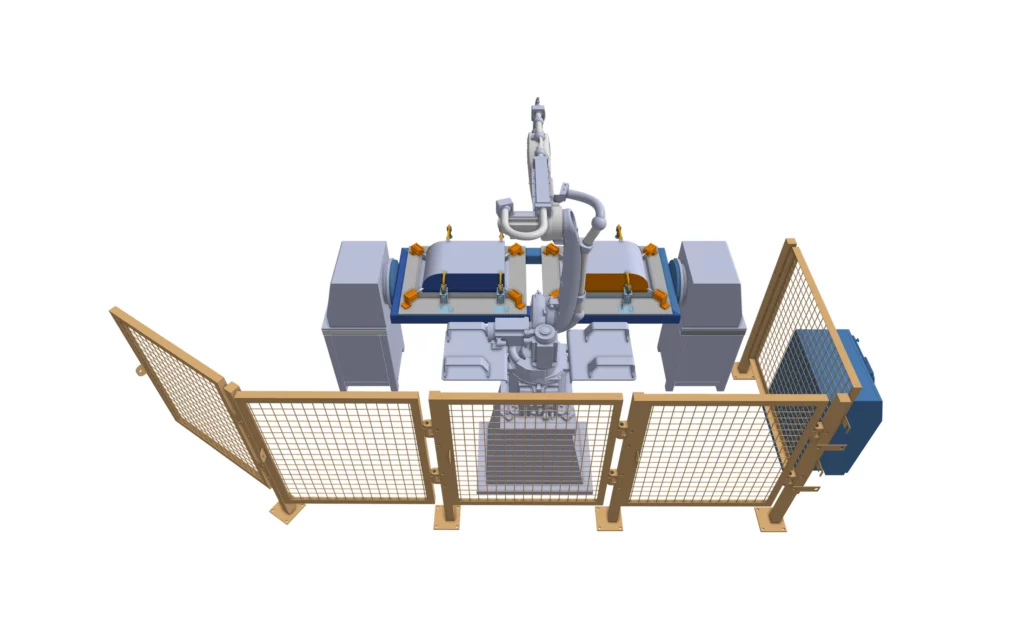
Key takeaways
- Robotic welding achieves 70 to 90% arc-on time, far exceeding manual welding’s 10 to 30%, but only when upstream design and fixturing are tightly controlled and operational setup/maintenance is rigorous.
- Process selection (MIG, TIG, laser, spot, friction stir, plasma) must align with geometry, material, and volume, not solely precision requirements.
- Most robotic welding failures originate in design, tolerance stack-up, and fixturing, not the roboticization process or equipment operation itself.
- ROI depends on volume, utilization, and labour substitution, with break-even typically occurring at sustained, repeatable production.
What is robotic welding?
Robotic welding is an advanced CNC manufacturing process in which programmable, typically multi-axis robotic arms perform welding operations with high precision, speed, and repeatability. Unlike manual welding, where outcomes vary with operator skill and fatigue, robotic welding delivers consistent weld quality across large production runs.
However, highly skilled and experienced operators (typically experienced welders) are required in setup, operation and maintenance of these systems, as the skills must be transferred to the equipment and its operation – they cannot entirely be encoded as drag-and-drop functions in a virtual environment.
First introduced in automotive manufacturing in 1962, robotic welding has evolved into a central plank of Industry 4.0 production systems. Robotic welding cells integrate real-time sensing, adaptive control, and digital monitoring, positioning them within broader Physical AI and Industry 4.0 ecosystems leading edge.
However, robotic welding should not be viewed as a standalone process. It is part of a closed-loop production system, where upstream variation and downstream requirements directly affect outcomes and must be assessed continuously to prevent unexpected deviations disrupting production.
How robotic welding works
Robotic welding begins with programming and ends with a finished weld, but the quality of outcome and the stability of the long-term setup results from the ways in which the system coordinates motion, sensing, and process control. These are expressions of the deep understanding and skills of the people defining the system components and their operation, and the quality-mindset that results from real world experience.
A typical system includes:
- A 6-axis robotic arm for positioning and orientation
- A welding torch/end effector
- Wire feed and shielding gas systems (for MIG/TIG)
- Sensors for seam tracking and adjustment
- A controller managing motion, voltage, current, and travel speed
When sourcing welded assemblies, direct communication with the fabricator is essential. Weld specifications, joint geometry, and fixture requirements must be clearly defined – platforms like Jiga concierge the critical direct engineer-to-manufacturer communication, avoiding the translation errors and additional middle-man communications delays that commonly cause defects.
Programming methods
Robotic welding can be programmed via teach pendants, offline simulation, or increasingly through AI-assisted systems that reduce manual input requirements.
While robotic welding setups appear very different from CNC machining centers, the programming skills and instincts are not so divergent.
System components
Each component must operate in coordination – small deviations in wire feed or torch position can lead to weld defects. Robotic welding systems integrate multiple coordinated components.
- The robot arm provides precise, repeatable motion across programmed paths.
- The welding power source controls arc (or plasma, or laser) and shield gas (where required), selecting and stabilizing parameters/characteristics and deposition rate/form.
- The torch and wire feeder deliver consumables with consistent positioning.
- Sensors (vision, temperature, seam tracking, arc feedback) enable adaptive correction.
- Fixtures and positioners stabilize and orient parts for access.
- Controllers synchronize motion, welding parameters, and safety systems.
When operating as planned, these elements deliver consistent repeatability of weld quality, penetration and integrity, minimized variability, and efficient high-volume production, in comparison with human operated processes.
Sensor feedback and real-time adjustment
Sensor feedback is the key element in adaptive control in robotic welding, enabling real-time modulation of parameters such as travel speed, arc voltage, wire feed rate, pool pattern, and torch position. Common inputs include vision systems, laser seam trackers, arc sensors, and thermal monitoring, which detect joint variation, distortion, and weld pool behavior. These signals allow closed-loop control to maintain consistent penetration and bead geometry despite part variability.
Physical AI enhancement expands this capability by applying deep learning to historical weld data to predict optimal parameters, detect anomalies, and compensate for upstream variation. Machine learning models can correlate sensor patterns with defect formation, enabling pre-emptive correction rather than reactive control, improving quality, reducing scrap, and enabling more autonomous welding in less structured environments.
Core robotic welding processes
Each robotic welding process serves a specific group of engineering applications and should be selected based on material, geometry, and production volume.
MIG welding (GMAW)
MIG welding is the most widely used robotic welding process, offering high speed and suitability for structural fabrication.
TIG welding (GTAW)
TIG welding delivers superior precision and weld quality but operates at lower speeds, making it suitable for critical joints but ill suited to high volume production of basic parts, reflecting the higher skill level the operation requires when human-performed.
Laser welding
Laser welding provides extremely high speed and minimal distortion, ideal for thin or precision components. It offers high penetration and extremely controllable parameters that make it an increasingly utilized method in both precision/quality applications and in high throughput service.
Resistance and spot welding
Spot welding dominates sheet metal assembly, particularly in automotive production. It was the first welding method to be robotized, and lies at the heart of sheet metal fabrication of all types.

Friction Stir Welding (FSW)
FSW produces high-strength joints without melting, ideal for Aluminium and aerospace structures. Requiring no filler material or shield gas, this is technically simpler to set up, for small, high strength nodes.

Plasma welding
Plasma welding enables precision joining in high-performance materials. It is more challenging to set up and stabilize, but yields excellent results in high-value applications.
Process comparison table
| Process | Best For | Materials | Speed | Precision | Volume |
|---|---|---|---|---|---|
| MIG | Structural fabrication | Steel, Aluminium | High | Moderate | High |
| TIG | Precision joints | Stainless, Titanium | Low | Very high | Low–medium |
| Laser | Thin, delicate parts | Steel, Aluminium | Very high | Very high | Medium–high |
| Spot | Sheet metal | Steel, coated steel | Very high | Moderate | Very high |
| FSW | High-strength joints | Aluminium, Copper | Moderate | High | Medium |
| Plasma | Micro welding | Nickel alloys | Moderate | Very high | Low–medium |
Key benefits of robotic welding
Productivity: 70–90% arc-on time
Robotic welding dramatically increases productive welding time, compared to manual processes. Error rates are very low, in well stabilized production, optimizing productivity and typically reducing finishing work and rework tasks.
Quality and consistency
Robots produce identical welds across production runs, reducing variability and rework.
Workplace safety
Robotic systems remove workers from hazardous environments involving heat, fumes, and radiation.
Long-term cost savings
Although capital costs are high, per-unit costs drop significantly at scale.
Limitations and challenges of robotic welding
High initial investment
Robotic welding cells typically cost $100k to $500k+, requiring volume justification to be able to extract a meaningful ROI from such high setup costs. This is only practical in stable, high volume production environments.
Programming and setup complexity
Significant expertise is required to program and maintain systems, adding to establishment costs and requiring deep welding knowledge AND programming capability.
Inflexibility for variable work
Traditional robotic welding struggles with high-mix, low-volume production, as re-tasking can be a major undertaking, both in setup and stabilization.
Maintenance and skills gap
Ongoing maintenance and skilled operators are required to sustain performance.
Where robotic welding projects break down
Most robotic welding failures are not primarily caused by the setup, they are caused by system-level misalignment and compromises that negatively influenced the equipment and operation choices that had to be made to execute on the design.
Common failure points include:
- Poor joint design, resulting in poor accessibility to weld paths
- Tolerance stack-ups allowing seam tracking failure
- Inconsistent fit-up causing sensor compensation limitations approached or exceeded
- Weak fixturing, typically a result of design-forced compromise, allowing part movement and distortion
- Supplier capability gaps can deliver inconsistent programming and setup quality
Robotic welding should be viewed as a matrix of dependencies, not an isolated process.
Fixturing: The hidden system that determines success
Fixturing is often the single most important factor in robotic welding success.
Key considerations:
- Repeatability: Fixtures must position parts identically every cycle, preventing slight variations in handling echoing through to positioning.
- Thermal stability: Welding heat can distort parts and fixtures and must be either prevented or accommodated.
- Clamping strategy: Over-clamping can deform parts before welding begins, building in errors and constrained stresses that cause fast errors and slow fatigue risks.
- Datum control: Consistent reference points are critical.
In many cases, a well-designed fixture improves weld quality more than upgrading the robot.
Design for Manufacturing: DFM for robotic welding
A robotically welded assembly is only as good as its design. Jiga enables engineers to receive real DFM feedback direct from the fabricators, not intruding into the communications channel except when specifically invited to guide. This ensures designs are manufacturable in actual production environments.
Multiple factors must be optimized:
Joint accessibility
Robotic torches require clear access and appropriate joint-presentation angles.
Fit-up consistency
Variation in part geometry directly affects weld quality, and must be moderated or excluded to ensure a quality/consistent result.
Joint type selection
Fillet, butt, and lap joints each have different robotic suitability.
Fixturing and part presentation
Parts must be presented consistently for repeatable welding. This is the primary cause of failure in volume processing, and can be the hardest issue to address fully.
Is your design suitable for robotic welding?
A quick assessment framework:
- Accessible joints? (clear line-of-sight for torch)
- Consistent geometry? (low variation across parts)
- Rigid components? (minimal deformation during clamping)
- Repeatable positioning? (fixture-friendly design)
If multiple answers are “no,” robotic welding offers a high risk of underperforming and being impossible to stabilize.
Robotic welding vs. manual welding
| Factor | Robotic | Manual |
|---|---|---|
| Arc-on time | 70–90% | 10–30% |
| Consistency | High | Variable |
| Volume fit | High | Low |
| Flexibility | Low | High |
| Cost (upfront) | High | Low |
Robotic welding excels in repeatable and steady productivity, while manual welding remains essential for variability and customization – and for those ‘the design must have….’ accessibility issues that can impose hybrid robotic and human welding solutions.
Robotic Welding ROI: When does it pay off?
Robotic welding becomes economically viable when:
- Volume is sustained (hundreds–thousands/month)
- Labour costs are significant
- Utilization is high (arc-on time maintained)
Payback Period ≈ System Cost ÷ Annual Labour Savings x Increased Throughput.
This calculation neglects a number of factors such as scrap rates, human welder productive-time ratio, health and safety factors and more.
However, real ROI depends on:
- Utilization rate
- Downtime
- Fixture costs
- Programming overhead
Industry applications of robotic welding
Here’s a structured overview of robotic welding applications and advantages across a broad range of sectors:
| Sector | Typical Applications | Advantages of Robotic Welding |
|---|---|---|
| Automotive | Body-in-white, chassis frames, exhaust systems, battery enclosures | High throughput, repeatability, consistent weld quality, integration with automated lines |
| Aerospace | Engine components, brackets, structural assemblies | Precision on complex geometries, reduced human error, improved traceability |
| Construction & Structural Steel | Beams, columns, bridge sections | High deposition rates, ability to handle large weld volumes, improved safety |
| Shipbuilding | Hull sections, bulkheads, piping systems | Consistent long weld seams, reduced fatigue for operators, scalability |
| Energy (Oil & Gas) | Pipelines, pressure vessels, storage tanks | High integrity welds, compliance with strict standards, reduced defect rates |
| Renewable Energy | Wind turbine towers, solar mounting structures | Repeatability on large components, efficient fabrication of modular systems |
| Heavy Equipment & Mining | Buckets, frames, wear components | Durability-focused weld consistency, handling of thick materials |
| Rail & Transport | Railcars, bogies, structural frames | Improved fatigue performance, consistent weld penetration |
| Medical Devices | Surgical frames, equipment housings | Clean, precise welds, suitability for small, high-value components |
| Electronics & Consumer Goods | Enclosures, brackets, heat sink assemblies | Fine control for thin materials, reduced distortion |
| Defense | Armored vehicles, weapon systems | Repeatable high-strength welds, reduced operator exposure to hazardous tasks |
| General Manufacturing | Fabricated assemblies, machinery frames | Flexible automation, reduced labor dependency, consistent output quality |
Collaborative robots (Cobots) in welding
Collaborative robots (cobots) are increasingly used in welding to combine automation with human flexibility. Systems from companies such as Universal Robots and FANUC allow safe operation alongside operators, reducing guarding requirements.
Cobots excel in low-to-medium volume production, quick changeovers, and variable part geometries, enabling smaller manufacturers to adopt robotic welding with lower cost, simplified programming, and faster deployment compared to traditional industrial robot cells. This provides a middle ground in automation, for tasks that are not suited to dedicated and inflexible full-automation.
Recent technological advances in robotic welding
AI-driven path adjustment
AI-driven path adjustment in robotic welding uses real-time sensor data and models from machine learning to dynamically correct torch trajectory, speed, and orientation. It dynamically compensates for joint variation, distortion, and fit-up errors, improving weld consistency, reducing rework, and enabling reliable automation in less controlled, high-mix manufacturing environments.
Systems like Path Robotics enable adaptive welding without manual programming.
3D scanning integration
3D scanning in robotic welding uses optical/camera or laser-based systems to capture precise joint geometry before and during welding, improving adaptive responses and improving input part variation tolerance.
Systems from Hexagon AB and FARO Technologies enable adaptive path planning, gap detection, and distortion compensation, improving weld outcomes, reducing fixturing requirements, and supporting high-mix, low-volume production environments.
Simulation and digital twins
Digital twinning in robotic welding creates a virtual replica of the welding cell, process, and parts/assemblies that mirrors real-world behavior. Platforms from Siemens and Dassault Systèmes enable simulation of weld paths, heat input, distortion, and cycle time before production commences, allowing the ironing out of many issues before even turning on the system.
By combining robot kinematics, fixtures, and process parameters, planners/programmers can optimize torch angles, sequencing, and access while offline. When linked to live sensor data, the twin predicts defects and facilitates real-time adjustment.
Over time, deep learning from the accumulated data improves accuracy, reduces commissioning effort, and supports predictive maintenance, making welding more adaptive and efficient.
Robotic welding is expanding - but not fully flexible
Robotic welding is increasingly viable for high-mix production, but limitations remain:
- Changeover times can be hard to predict and hard to reduce.
- Fixture redesign requirements require smart, highly interchangeable jigs that require no installation alignment but have their precision built-in.
- Programming complexity can raise challenges, as this requires highly skilled labor and extensive review/tuning.
The boundary is shifting, but not eliminated.
Finding the right welding supplier
Robotic welding capability varies significantly between suppliers.
Jiga connects engineers directly with vetted welding shops, ensuring alignment from prototype through production.
| Skill Area | What Good Looks Like | How to Assess It |
|---|---|---|
| Welding Process Expertise | Deep knowledge of MIG, TIG, laser, and hybrid processes across materials and thicknesses | Review weld procedure specifications (WPS), ask for sample parts, inspect macro sections and certifications |
| Robotics Integration | Strong capability with major platforms like FANUC, ABB, or KUKA | Request cell layouts, programming examples, and offline simulation outputs |
| Fixture & Tooling Design | Robust fixturing that minimizes distortion and ensures repeatability | Review fixture designs, tolerance stack-ups, and changeover methods |
| Sensor Integration | Use of seam tracking, vision, and arc sensing for adaptive control | Ask for examples of closed-loop systems and real-time adjustment capability |
| Programming & Path Optimization | Efficient toolpaths, correct torch angles, and minimized cycle times | Review program logic, dry-run simulations, and cycle time benchmarks |
| Quality Assurance & Inspection | Defined QA processes with traceability and defect control | Check inspection reports, NDT capability, and adherence to standards (e.g. ISO, ASME) |
| Materials & Metallurgy Knowledge | Understanding of weld behavior across steels, aluminium, stainless, and alloys | Discuss past projects, heat input control, and distortion mitigation strategies |
| Production Scalability | Ability to move from prototype to volume without quality drift | Evaluate capacity, automation level, and historical production ramp examples |
| Data & Digital Capability | Use of digital twins, data logging, and process monitoring | Ask about platforms (e.g. Siemens), data capture, and analytics use |
| DFM & Engineering Support | Proactive feedback on weldability, joint design, and cost reduction | Assess early-stage engagement, example design improvements, and responsiveness |
| Maintenance & Reliability | Preventive maintenance and uptime management for robotic cells | Review maintenance schedules, downtime metrics, and spare parts strategy |
| Health & Safety Compliance | Strong safety systems for robotic welding environments | Inspect guarding (if applicable), cobot safety measures, and compliance records |
System Integration: Welding is not isolated
Robotic welding performance depends on:
- Cutting accuracy
- Forming consistency
- Pre/post machining
- Inspection processes
Failures often originate upstream, not in the welding operation itself but in the equipment/reasoning that is set up to execute on it.
Is robotics welding right for your operation?
Robotic welding is the right choice when:
- Volume is high
- Weld access is good
- Geometry is consistent
- Quality requirements are strict
- Skilled labour is scarce
Regardless of process, supplier capability determines outcomes.
Jiga provides direct access to qualified suppliers, enabling consistent results from prototype through production and acting as concierge and right-hand support on the supply journey.