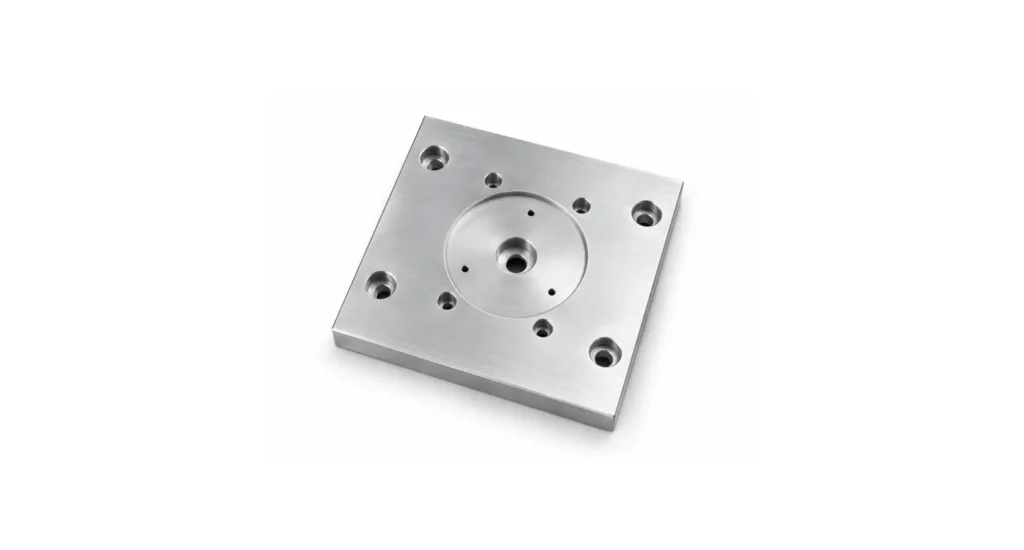
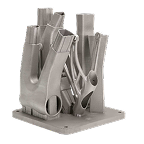
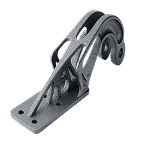
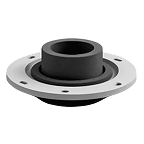

Wire Electrical Discharge Machining (EDM) is a high-precision, non-contact CNC cutting process used to produce fine quality, unrestricted and narrow KERF cuts in electrically conductive materials. In place of physical-ablation, edge-contact cutting tools, wire EDM removes material through controlled electrical discharge, generated between a thin wire electrode and the workpiece. The discharge locally vaporizes the target material, the wire traverses the cut path – and its own ablation is countered by continuous, longitudinal feed.
The process excels where extreme precision, sharp internal corners, and high Rockwell-value hard materials make conventional machining impractical.
This guide seeks to explain in depth the mechanisms by which wire EDM works; what materials it is suited to; its precision limits; its applications; and how engineers should tackle sourcing wire EDM machining services for critical parts.
Key takeaways
- Wire EDM is a non-mechanical, full depth cut process that removes material using spark erosion generated through discharges between a linear feeding wire electrode and any conductive workpiece
- Wire EDM machining achieves tolerances as tight as ±0.0001″ (2.5 µm) and surface finishes down to 4 Ra µin, through tight control of discharge parameters, feed rates and immersion in dielectric coolant that tightly controls operational heat, avoiding any build-up.
- The process can cut any electrically conductive material, including hardened steel, Tungsten-carbide, Titanium, and exotic alloys.
- Because there is no cutting force, wire EDM produces burr-free parts with zero process-induced distortion and no creation of residual stress.
- Notably, pre-existing internal stresses in the workpiece must be managed prior to sire EDM processing, to achieve the highest tolerances.
- Typical wire EDM applications include mold and die components, medical devices, aerospace parts, and high-precision tooling

What is Wire EDM machining?
Wire EDM machining is a subtype of the broad electrical discharge machining (EDM) capability, in which a continuously fed wire acts as the cutting electrode.
The wire, most commonly brass or coated brass, is electrically charged relative to the conductive workpiece. As the wire approaches the material, precise and closely controlled electrical discharges arc across the wire-to-workpiece gap, vaporizing/melting material in extremely fine increments at the multiple arc sites.
This is a non-contact process: the wire never physically touches the part. Material removal occurs through localized melting and vaporization, resulting directly from the electrical discharge. The cut zone is submerged in deionized water or dielectric oil, which serves as an insulating fluid to control spark formation by raising the breakdown EMF required for arc formation; as coolant for the cut the area; and to flush away eroded slag and detritus.
The fundamental requirement for the workpiece is electrical conductivity. Metals and alloys can be cut, including hardened and heat-treated materials. Non-conductive materials such as plastics, ceramics, and glass cannot be processed by this.
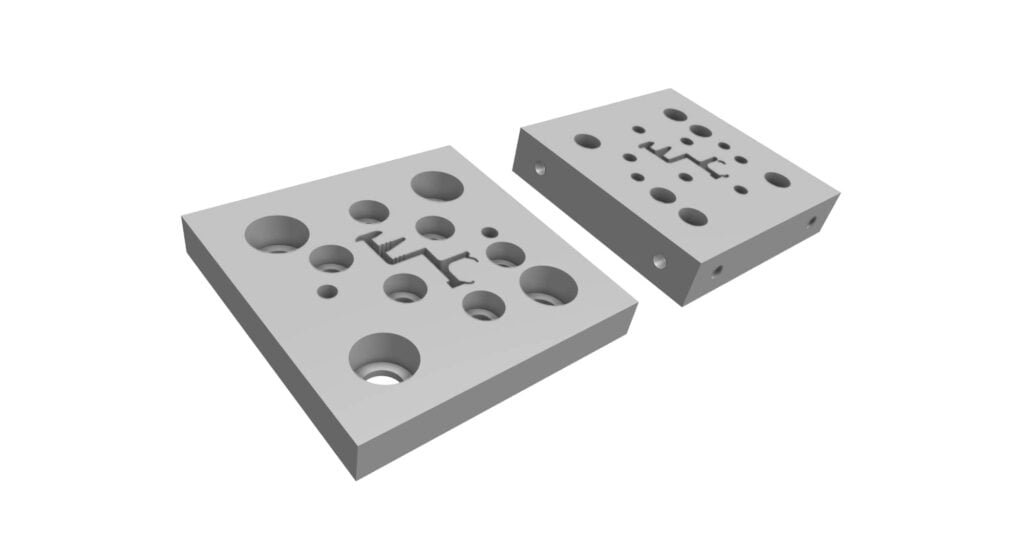
How Wire EDM differs from conventional machining
Unlike CNC milling or CNC turning, wire EDM:
- Applies no mechanical cutting forces
- Is unaffected by material hardness
- Produces sharp internal corners without tool access constraints
- Eliminates burrs and tool wear concerns
Conventional machining relies on physical cutting by edged tools, which limits corner radii, induces stress, and struggles with hardened or abrasive materials.
The role of electrical conductivity
Electrical conductivity is mandatory. If a material cannot conduct electricity, arcing cannot occur. This requirement defines both the power and a limitation of wire EDM.
The Wire EDM machining process: Step by step
This following details the wire EDM machining process as it is executed in a range of specialist and more general machining suppliers.
Setup: Wire threading and workpiece positioning
A thin wire (typically 0.004″ to 0.012″ (0.10–0.30 mm) diameter) is automatically threaded through start holes in the workpiece or positioned at the external start of a planned cut. Start holes may be drilled, laser drilled etc., where internal features are to be cut, making a side entry impossible.


The electrodes: Wire and workpiece
The wire acts as one electrode; the conductive workpiece acts as the other. The wire is continuously fed from an upper spool of virgin wire to a waste spool that is typically recycled as high quality scrap. This constant feed process serves to maintain consistent diameter and surface condition, as the wire tends to erode at a similar rate to the workpiece, so used and eroded wire is fed through to be replaced by new, before its reduced diameter adversely influences the cut or risks fracture.
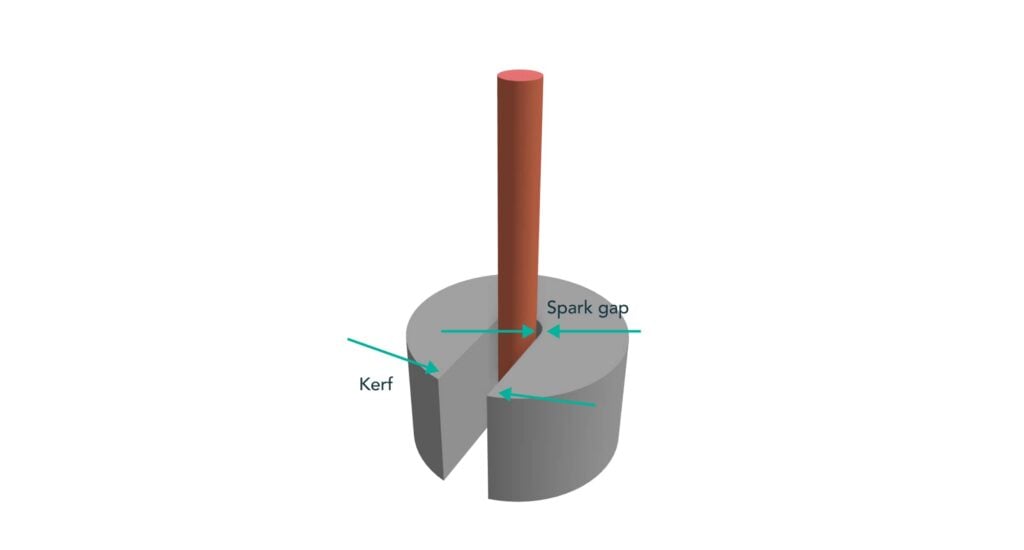
Spark gap control: Non-contact cutting
A precise spark gap (on the order of microns) is maintained, with spark-gap consistency being key to maintaining cutting parameters. The wire never touches the part, preventing any potential for snagging or mechanical distortion. The feed mechanism must avoid any risk of introducing kinks into the wire.
Electrical discharge: How material is removed
Thousands of sparks per second cross the electrolyte between the wire and the work piece. Each discharge is a tightly controlled, rapid, recurring electrical discharge that each act as microscopic, high-temperature plasma explosions. They erode material by melting and/or vaporizing microscopic particles. Each discharge removes a tiny volume of the target material (and the electrode wire), allowing extremely controlled material removal with no adverse bulk effects.
The dielectric fluid functions
Most basic machining is performed in a deionized water bath, to act as a dielectric fluid. In some cases, petroleum based or synthetic oil based fluids are used, for tighter control in micromachining applications. Some medical applications use vegetable oils for this task, to remove any risk of harmful contaminants. All types of dielectric fluid function in essentially the same ways;
- They control spark formation by imposing a high breakdown voltage in the gap, enhancing the spark effect by shortening each discharge duration and increasing momentary intensity
- They cool the cutting zone, reducing recast thickness
- They flush away debris that might induce local short circuit and disrupt machining
CNC control: Programming the cut path
Multi-axis CNC control guides the wire along complex paths, including tapers and variable profiles. The typically vertical path of the wire can be angled in two axes to produce moderate complexity and limited 3d curvature.
At all times, the wire and the immediate cut are straight, whatever the orientation to the cut part.

Tight tolerance wire EDM machining: Precision capabilities
Wire EDM delivers otherwise near-impossible levels of precision and low stress/temperature cutting of the hardest (conductive) materials. It’s for these reasons engineers select the process, typically for difficult and high value components with exacting specifications.
Achievable tolerances
Current standard machines routinely achieve ±0.0005″ (±0.0127 mm), with high-precision setups reaching ±0.0001″ (2.5 µm).
Surface finish quality
Surface finish can be affected by vaporized and condensed (or melted and redeposited) cutting residues, termed recast. It is common to use multiple skim passes to reduce the recast effect and deliver higher quality surface finish.
Kerf width and fine feature capability
Kerf is the term used for the gap created by wire transit and ablation. The kerf width is closely tied to wire diameter and spark gap and can be affected by alterations in parameters, during cutting.
Sharp internal corners and complex geometries
Internal corner minimum radius is approximately the wire radius, enabling near-sharp internal corners.
| Capability | Typical Range | Best Achievable |
|---|---|---|
| Dimensional tolerance | ±0.0005" | ±0.0001" (2.5 µm) |
| Surface finish | 8–16 Ra µin | 4 Ra µin |
| Kerf width | 0.010–0.012" | 0.006" |
| Internal corner radius | Near zero | Limited by wire diameter |
Common materials for wire EDM machining
There are various material, and material class specific issues that affect the process, tolerance level and quality of cut achieved by wire EDM.
However, as a rule, if the material is a moderate to good conductor it is possible to wire cut it.
The conductivity requirement
Only conductive materials can be processed, as there must be a current path for arcing to take place. Lower conductivity imposes certain pre-conditions that must be accommodated, as can brittleness and extreme hardness.
Hardened steels and tool steels
Wire EDM cuts parts that have already undergone heat treatment and stress relief, eliminating the distortion from post-machining hardening that otherwise requires subsequent processes to recover flatness and precision vision. This is a huge advantage in plastic mold and dud cast tools, obviating the need for multiple machining steps that post-machining heat treatment imposes.
Carbide and tungsten alloys
Wire Electrical Discharge Machining (WEDM) is a crucial non-conventional method for processing tungsten carbide due to the material’s extreme hardness and resistance to traditional machining.
Machining carbide is inherently slower than with softer metals, in order to prevent thermal micro-cracks forming and maintain surface finish.
Key parameters like pulse on-time and off-time, and peak current are used to compromise between material removal and surface quality, typically using low-ablation skim cuts.
Titanium and titanium alloys
Ti-6Al-4V and related alloys cut without undergoing any work hardening. This is a significant benefit in wire EDM that should not be underestimated, as the work hardening problem is a profound barrier in edge-tool based CNC machining of any high-Titanium content alloy.
Exotic and high-performance alloys
Superalloys are typically much easier to process by wire EDM than be use of conventional CNC processing. This result from avoidance of the high cutting forces, rapid tool wear, and work hardening associated with machining their Nickel and Cobalt components. Wire EDM is essentially uninfluenced by material hardness, other than the risk of microfracturing, which is controlled by cutting parameters tuned to particular alloys. It is entirely unaffected by the strength of materials, maintaining accuracy in heat-resistant AND heat sensitive alloys, and reliably produces geometries that are difficult/impossible and costly to achieve with conventional CNC machining.
Aluminum, brass, and copper
Aluminum, brass and Copper alloys machine exceptionally well by wire EDM due to their high electrical conductivity, which enables stable, highly energetic arcing. The process produces clean, burr-free cuts with excellent dimensional accuracy, rendering it ideal for intricate profiles, tight tolerances, and thin sections that are difficult or impossible to machine conventionally.
Advantages of wire EDM machining
Wire EDM offers a wide range of benefits that differ according to equipment and target material:
Burr-free, stress-free cuts
Wire EDM delivers burr-free cuts because material is removed by controlled electrical erosion rather than mechanical shearing, eliminating plastic deformation at edges and leaving sharp, clean profiles, without the need for secondary deburring operations.
No tool wear or breakage
Wire EDM experiences minimal tool wear and no tool breakage from cutting forces, since the wire never contacts the part mechanically and is continuously renewed during machining. While the wire IS eroded during cutting operations, the continuous feed that it undergoes removes the ‘worn’ section before the damage can cause any knock-on in cut performance.
Cutting hardened materials after heat treatment
Wire EDM offers major advantages when cutting pre-hardened materials because its non-contact process is unaffected by target-material hardness, toughness, or strength. By eliminating cutting forces and feeding the electrode wire continuously, it obviates any tool wear issues, induces no work hardening, and produces precise, burr-free features in hardened steels and superalloys. This is critical for dies, molds, and fatigue-sensitive parts that require precision AND extreme hardness, negating the need for finesse machining after heat treatment distortions have taken place.
Complex geometries without tool access limitations
Where the geometry allows a straight line, through-cut approach, there is simply no concern for tool reach or clearance, making curvatures and feature sizes unlimited in their tightness and proximity.
Reduced or eliminated secondary operations
As parts typically exit wire EDM in complete and use-ready form, savings in cost and time for further processing can be considerable, often more than offsetting the relative slowness (and therefore machine-time cost) of the process itself.
Design freedom: Sharp corners and intricate features
Features impossible to mill are routine in wire EDM. This gives designers considerable (two dimensional) freedom, removing the constraints that bulky-cutter processes impose.
Design considerations that favor wire EDM
| Design Consideration | Why This Favors Wire EDM |
|---|---|
| Very tight tolerances | Wire EDM routinely achieves ±0.005 mm or better with excellent repeatability. |
| Sharp internal corners | The wire radius (plus spark gap) defines the corner radius, enabling much sharper corners than milling. |
| Burr-free edge requirement | Non-contact spark erosion eliminates mechanical burr formation. |
| Pre-hardened or heat-treated materials | Cutting performance is unaffected by hardness or strength. |
| Thin sections or delicate features | No cutting forces, so parts do not deflect or distort. |
| Complex internal profiles | Precise contouring without tool-access limitations. |
| High aspect-ratio slots | Deep, narrow cuts are possible without tool chatter or breakage. |
| Minimal post-processing | Clean edges and accurate geometry reduce secondary finishing steps. |
Limitations and considerations of wire EDM machining
| Limitation / Consideration | Why It Affects Wire EDM Selection | Material Family Specifics |
|---|---|---|
| Electrically conductive materials only | Wire EDM relies on electrical discharges. | Suitable for steels, tool steels, stainless steels, superalloys, Titanium, Copper alloys; not suitable for plastics, ceramics, glass, or fiber-reinforced polymers. |
| Slower cutting speeds | Material is removed by spark erosion, not shearing. | Particularly slow in thick hardened tool steels and superalloys; comparatively faster in Copper, brass, and Aluminum. |
| Higher per-hour machine cost | EDM machines, wire, and dielectric fluid add operating cost. | Cost impact is easier to justify for hard materials (tool steels, Inconel) than for soft Aluminum or mild steel. |
| Starter hole requirement | Wire must pass through the workpiece. | Requires drilling or laser start holes in hardened steels and carbides; trivial in Aluminum and mild steels. |
| Heat-affected / recast layer | Electrical discharge alters a thin surface layer. | More critical for tool steels, aerospace alloys, and fatigue-loaded components; often removed by skim cuts or polishing. |
| Surface finish tradeoff | Fine finishes require multiple skim passes. | Hardened steels and superalloys need more skim passes than copper or brass to reach low Ra values. |
| Edge integrity concerns | Micro-cracking possible if parameters are poor. | High-strength steels and superalloys are more sensitive; Copper alloys typically show excellent edge quality. |
| Limited 3D geometry capability | Wire EDM excels in 2.5D profiles. | Not suitable for complex 3D surfaces, where 5-axis milling is more efficient. |
| Thickness limitations | Very thick sections increase cut time dramatically. | Thick tool steels and superalloys (>100 mm) become time-intensive; thinner plates of copper/brass are ideal. |
| Overkill for soft, machinable metals | Other processes are faster and cheaper | Milling or laser cutting is usually preferred for Aluminum, mild steel, and plastics unless tolerances or edge quality demand EDM. |
Wire EDM applications by industry
The applicability and benefits of wire EDM are subject to fine-tuning according to application type, industry sector and material families:
| Industry | Typical Materials | Wire EDM Benefits | Additional Considerations |
|---|---|---|---|
| Aerospace | Nickel superalloys (Inconel), titanium alloys, hardened stainless steels | Cuts extremely hard, heat-resistant alloys without tool wear; achieves tight tolerances and sharp internal corners | Thin recast layer may need removal for fatigue-critical parts; ideal for low–medium volumes |
| Medical devices | Stainless steels, cobalt-chromium, titanium | Burr-free edges, excellent dimensional control, minimal mechanical stress on delicate features | Supports implants and surgical tools where edge quality and precision are critical |
| Automotive and motorsport | Tool steels, hardened steels, aluminum alloys | Ideal for hardened dies, gears, and precision slots; no distortion on heat-treated parts | Often used for tooling and prototypes rather than high-volume production parts |
| Mold and die | Pre-hardened tool steels, carbide inserts | Machines hardened materials directly; produces sharp internal corners impossible by milling | Slower than milling for roughing; commonly hybrid processed with CNC milling |
| Energy and power generation | Superalloys, stainless steels, high-strength steels | Accurate cutting of thick, hard sections with no cutting forces | Valuable for turbine, valve, and sealing components where precision outweighs speed/cost |
| Electronics and connectors | Copper, brass, beryllium copper | High electrical conductivity enables fast, stable cutting with excellent edge quality | Enables fine features and thin sections without burrs |
| Defense | Hardened steels, superalloys | Maintains precision on very hard materials and complex profiles | Useful for classified or low-volume, high-precision components in this cost-insensitive sector |
| Research and prototyping | Wide range of conductive metals | Flexibility to machine difficult geometries without custom tooling | Slower cycle times acceptable due to design-iteration focus |
Wire EDM machining services: Sourcing and supplier selection
As with most outsource machining requirements, supplier selection, integration and management are the keys to effective and cost-moderated outcomes that serve the product need.
When to outsource wire EDM
Most machine basic and in-house shops do not own advanced wire EDM equipment. Outsourcing is therefore common and often unavoidable, to achieve the full benefit of the processes potential.
Evaluating supplier capabilities
When selecting wire EDM suppliers, assess machine capability (maximum work envelope, wire diameter range, multi-pass and taper cutting), material experience, and achievable tolerances. Verify process control for recast layer management, surface finish, and edge integrity, particularly for fatigue-critical parts. Inspection capability is essential: confirm CMM availability (and operational proficiency), calibrated metrology, and externally regulated quality systems. Review evidence of similar parts, operator expertise, and communication practices that enable early DFM feedback and realistic quoting.
Jiga acts as a unitary interface and concierge for multiple suppliers, matching parts to vetted EDM specialists, enabling direct machinist communication, and ensuring capability-based routing for materials, tolerances, and industry-specific requirements.
Information to provide when requesting quotes
The data to provide for quotation is essentially identical to that required for any engineering part quotation:
- Material and thickness
- Tolerance requirements
- Surface finish targets
- Start-hole details – this being a unique requirement of wire EDM that can have significant knock-on effects
Quality and inspection requirements
Wire EDM parts demand CMM measurement, optical or laser edge inspection, surface roughness verification, recast layer assessment, and documented traceability to confirm dimensional accuracy, geometry, and edge integrity.
Communication and DFM feedback
Effective communication with wire EDM suppliers enables early DFM feedback on feature feasibility, start-hole placement, recast layer control, taper limits, and tolerance realism. Direct machinist input will often refine profiles, reduce skim passes, prevent rework, and ensure parts meet functional and quality requirements at moderated cost.
Why platform choice matters for wire EDM
General-purpose platforms, such as Xometry and Protolabs, may route work to inadequately equipped shops. Jiga matches projects to verified suppliers with the exact machine capabilities, inspection methodologies, and industry certifications.
Wire EDM vs. Other precision machining processes
| Factor | Wire EDM | CNC Milling | Laser Cutting |
|---|---|---|---|
| Material compatibility | Conductive metals only (tool steels, superalloys, Ti, Cu alloys) | Almost all metals, plastics, composites | Metals and some plastics (best for thin sections) |
| Sensitivity to material hardness | Unaffected by hardness | Strongly affected (tool wear, forces) | Moderately affected |
| Cutting forces | None (non-contact) | High | Very low |
| Edge quality / burrs | Burr-free, sharp edges | Burrs common, secondary deburring | Minimal burrs, HAZ possible |
| Achievable tolerances | Very high (±0.005 mm typical) | High (±0.01–0.05 mm typical) | Moderate (±0.05–0.1 mm) |
| Surface finish (Ra) | Good–very good with skim passes | Good | Fair |
| Internal corner capability | Extremely sharp (wire diameter limited) | Limited by tool diameter | Limited by kerf |
| Heat-affected zone | Thin recast layer | None | Present (HAZ) |
| Cutting speed | Slow | Moderate–fast | Very fast |
| Thickness capability | Excellent, slower with thickness | Very good | Limited for thick sections |
| 3D geometry capability | 2.5D profiles, limited tapers | Full 3D | 2D profiles |
| Tooling wear | No traditional tool wear | Significant in hard materials | Optics wear |
| Typical applications | Hardened tooling, dies, precision slots | Structural parts, complex 3D components | Sheet metal, enclosures |
Summary
Wire EDM machining is the process of choice for precision cutting in electrically conductive materials, especially when tight tolerances, sharp internal corners, or hardened materials are required. Its non-contact nature eliminates burrs and distortion, making it essential for tooling, medical, aerospace, and high-performance components. Jiga simplifies sourcing by connecting engineers to vetted wire EDM machining services with verified capability, inspection standards, and industry certifications for custom parts.